Is Google Translate Accurate? A Dated Test, Pair by Pair
You paste a message into a translator, the Spanish comes back fluent, and you send it. Then the reply arrives in a register you didn't expect, or a number looks wrong, and you can't tell whether Google Translate is accurate here or your sentence was the problem.
Short version: on short, everyday sentences in a big European language it holds up, and on idioms, names and numbers, polite address and scripts far from English it slips. We put ten sentences through it on 22 November 2026, five English to Spanish and five English to Hindi, and scored every output by hand. The gap between those two sets is the answer.
Below is what we ran and how we scored it, where the Spanish held and where the Hindi broke, why no single accuracy percentage is honest, and a one-minute test you can run on your own sentence. It's written for anyone who has to send a message in a language they read only partly.
Is Google Translate accurate? The short answer
For the sentences people actually translate, usually yes. Our five everyday English sentences came back as Spanish a reader would send unchanged, and the engine picked a register for each one without being told which.
Our five hard sentences are the other picture. None of the five came back as Hindi we'd send unchanged, and three of the five changed the meaning.
That isn't a percentage and we won't dress it up as one. Ten sentences tell you which shapes of sentence break and which pairs to watch. They can't tell you what share of all translation is right, and neither can any article that prints one number.
What we ran, and how we scored it
Ten sentences, picked for the things that go wrong rather than to flatter either engine: five ordinary English sentences, and five carrying an idiom, a politeness problem, or a name and a number. Google's column below is what its public translate endpoint returned, one sentence per call, on 22 November 2026.
The fusionchat.ai Hindi column is not a live run for this post. It's our own English to Hindi pair record, captured on 17 November 2026 with gpt-5.1-2025-11-13. fusionchat.ai runs GPT models for this tool, so the two engines can be put side by side on the same sentence, and on one of them they return the same words.
One rule, applied to every output of both engines:
kept if a bilingual reader would send the output unchanged;
partly kept if the information survives but the wording or the register needs an edit;
changed if something in the meaning differs.
One of us did the judging, reading each output against its own source sentence in both languages. There was no second rater and no agreement score. Ten hand-picked sentences are not a sample, so we report no aggregate rate of our own anywhere in this post.
Where Google Translate is accurate: English to Spanish, five of five kept
Spanish is the pair readers ask about most, and ours came back clean: all five outputs were kept. So how accurate Google Translate is for Spanish in one line: on these five sentences, five out of five kept, with the engine choosing the register in three of them.
| Sentence | Google Translate, 22 Nov 2026 | Score | Register |
|---|---|---|---|
| Could you send me the document? | ¿Podrías enviarme el documento? | kept | tú |
| Ask Mr. Okafor for invoice 4021 before 5 May. | Solicite al Sr. Okafor la factura 4021 antes del 5 de mayo. | kept, name, number and date exact | usted |
| She left because she was tired. | Se fue porque estaba cansada. | kept, subject dropped, feminine agreement kept | none |
| It's raining cats and dogs. | Llueve a cántaros. | kept, idiom replaced rather than translated | none |
| I'll call you tomorrow at 3 p.m. | Te llamo mañana a las 3 p.m. | kept | tú |
Two things to name before you read that as safe. The register first: from an English that never says how close the two people are, the engine chose tú in rows 1 and 5 and usted in row 2. A Spanish-speaking colleague might have made a different call, and nothing in the English told the engine which one to make.
Second, length. Every one of those five is a single clause, and none of them carries a clause of a contract, a dosage or an amount of money. Kept on these five is evidence about short everyday Spanish, not a licence for a document.
Where it breaks: English to Hindi, three of five changed
Google's column scored 0 kept, 2 partly kept and 3 changed. Our own translator's column scored 0 kept, 3 partly kept and 1 changed, with the fifth row not scored at all.
| Sentence | Google Translate, 22 Nov 2026 | Score | fusionchat.ai, 17 Nov 2026 | Score | The record's corrected form |
|---|---|---|---|---|---|
| Could you sit here, please? | क्या आप कृपया यहाँ बैठ सकते हैं? | partly kept, a polite plea framed as a question of ability | क्या आप यहाँ बैठ सकते हैं, कृपया? | partly kept, same fault, कृपया moved to the end | आप यहाँ बैठिए। |
| I have a frog in my throat. | मेरे गले में एक मेंढक है. | changed, the frog stayed | मेरे गले में मेंढक अटका हुआ है। | changed, the frog stayed, now "stuck" | मेरा गला बैठा हुआ है। |
| I am feeling under the weather. | मैं खराब मौसम का अनुभव कर रहा हूं। | changed, reads as "I experience bad weather" | मेरा तबीयत ठीक नहीं लग रहा है। | partly kept, agreement is off | मेरी तबीयत ठीक नहीं लग रही है। |
| Give me the book. | मुझे किताब दो. | partly kept, तुम imperative | मुझे किताब दो। | partly kept, same imperative | मुझे किताब दीजिए। |
| What is the internet? | इंटरनेट कहाँ है? | changed, asks where | not scored, brief-sourced, see below | none | इंटरनेट क्या है? |
On the book sentence the two engines returned the same wording, one punctuation mark apart: Google's मुझे किताब दो. closes with an ASCII full stop and our captured string is मुझे किताब दो। with the Devanagari danda. That is the only like-for-like row in the set where both strings were captured, and it is one row.
The last row is why we don't count a second match. Our string for "What is the internet?" is इंटरनेट कहाँ है?, identical to Google's, but the record marks it as written from a brief rather than captured from the model, so it can't be scored as an output.
Against the single corrected form the record keeps for each sentence, neither engine matched one: Google 0 of 5 and fusionchat.ai 0 of 5. Read that as a match against one chosen correction, which is one editor's opinion of the best Hindi for the line, and not as an accuracy rate.
So is an AI translator more accurate than Google Translate? On this evidence there's no gap in the meaning work, because both engines slipped in the same place. Our own English to Spanish record holds five misses from 17 November 2026 on gpt-5.1-2025-11-13, and three of them are register slips to tú: "Por favor, siéntate.", "¿Puedes ayudarme?" and "¿Tienes un bolígrafo?", where the record's own fixes take usted. Google made the same kind of guess from the same silence in the English.
Why no single "how accurate is Google Translate" number exists
Any article answering this has to point at something. Most point at the same evaluation: 330 of 400 sentences correct, 82.5%, varying by language from 55 to 94%, with Spanish at 94%, Korean at 82.5%, Mandarin at 81.7%, Farsi at 67.5% and Armenian at 55%. Those are cited numbers, not ours. We didn't rerun that study and we can't vouch for its sentence set.
JotMe's October 2026 test runs five examples, prints a five-row Correct / Partially correct / Literal table, and says of them "They are not a statistical sample, so we do not report an aggregate accuracy rate". That's the right call at five items, and it's why our own ten get no aggregate rate either. Linguise's July 2025 guide reprints the UCLA figures beside a European table with no source given, which is why no table of ours looks like that one.
On Google Translate vs DeepL accuracy, note what we did not run: no DeepL output appears in this post, because we tested no DeepL. What can be reported is Lokalise's comparison, that DeepL covers 29 languages against Google's over 130, with DeepL ahead for German, French and Spanish and Google ahead for Arabic, Korean, Brazilian Portuguese and Mandarin, drawing on a DeepL-run study and the Intento report. If that ranking matters for a pair you actually use, run your own sentence through both; a ranking across languages is not a promise about your line.
The reason no single figure holds is that the score moves with four things at once: the pair, the kind of sentence, the register the sentence implies, and the rule the scorer applies. A study of clinic letters and a study of chat messages are not measuring one quantity, which is why a number quoted without its sentence set is decoration.
The failure cases to test in your own text
Names and numbers. Our invoice sentence came back with "Okafor", "4021" and "5 de mayo" intact. Keep testing it anyway: a name is the one token an engine has no reason to keep and every reason to translate.
tú and usted. English has one "you" and Spanish has two, so the engine picks, and it picked in three of our five rows. If the relationship matters, the politeness has to be in your words, because there's no register setting on the page to tell it with.
Omitted Spanish subjects. "Se fue porque estaba cansada." drops the subject and keeps the feminine ending, so a gender that English did keep has moved into an adjective. If your English says "they" and the Spanish needs a gender, say which one in the source.
Idioms. Sometimes the engine replaces one cleanly, as with "Llueve a cántaros.". Sometimes it keeps the animal, as in मेरे गले में एक मेंढक है. for a frog in the throat.
Non-Latin scripts. This is where our test was worst: three of five Hindi outputs changed the meaning. Send a short sentence in a script you can't read and you have no cheap way to notice.
Which languages to distrust: Google's 130+ against the 35 in our menu on 22 November 2026
Coverage is the first thing to check, and the two numbers are far apart. Lokalise puts Google's coverage at over 130 languages. The target-language menu on our translator held 35 languages on 22 November 2026, and its last row was "Indonesian".
Urdu, Tamil and Tagalog are not in that menu: searching it for "urd" leaves the grid empty. The code's own language list already carries three more rows than the menu serves, so 35 is a snapshot of the menu on that date and not a fixed figure. The guide we published earlier already prints the same count and the same absences.
What that means for trust: the pairs with the least training data are the ones where a fluent-sounding output is most dangerous, because fluency is what the engine is best at. If your pair is high-resource, our Spanish set is closer to what you'll meet. If it's not in the menu at all, the question isn't accuracy, it's whether you have any output to check.
How to check a translation is accurate in a minute
Open the free AI translator, paste the sentence you actually need, and work through the four steps below. If you want the mechanics of pasting, swapping and clearing in more detail, How to Translate a Text Message Without an App already walks them.
Paste your sentence
Put the sentence in the box, not a summary of it. The card is two language menus, a box and an output panel reading Your translation will appear here, and there's no upload control and no image input, so pasting or typing is the only way in.
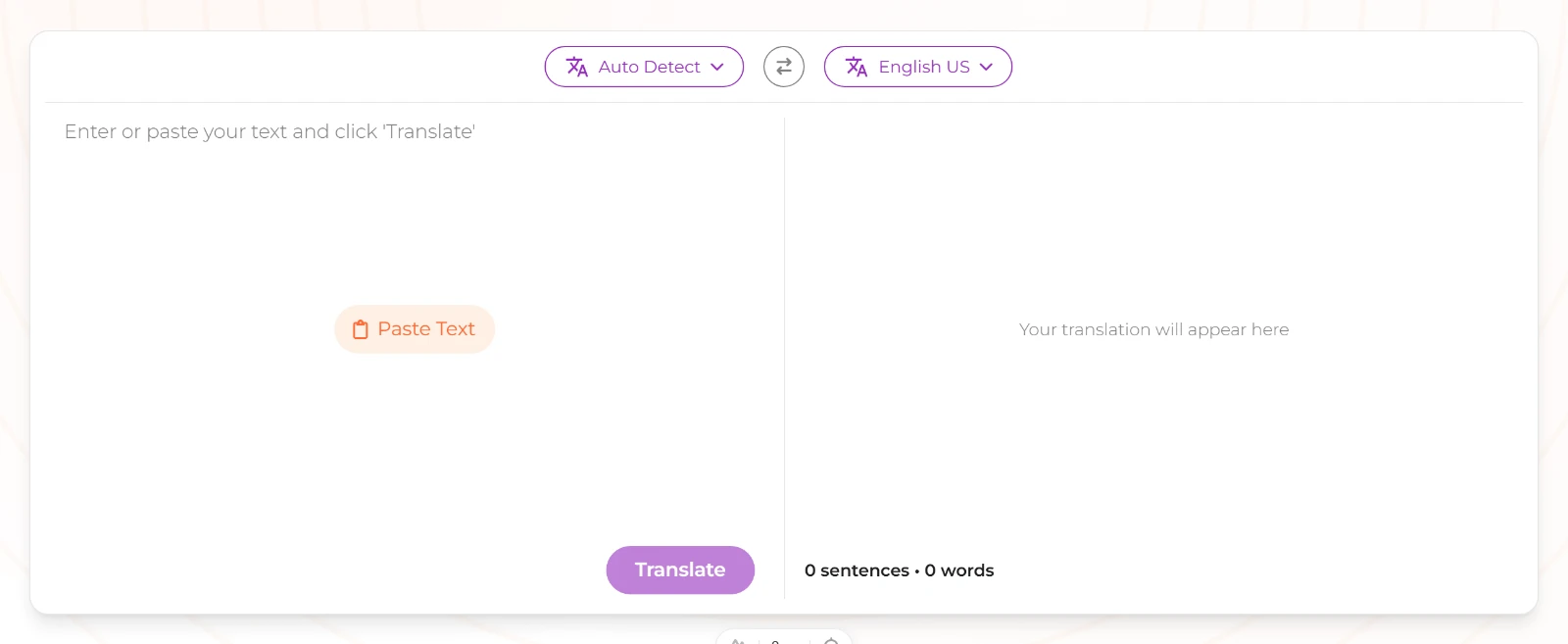
Two menus, a box and an output panel. That is the whole setup for the test below. Set both menus
The left menu starts on Auto Detect and the right on English US. Open the right-hand one and pick your target, and leave the left on Auto Detect unless the sentence mixes languages. One run takes up to 50,000 characters, and the same language on both sides is refused outright.
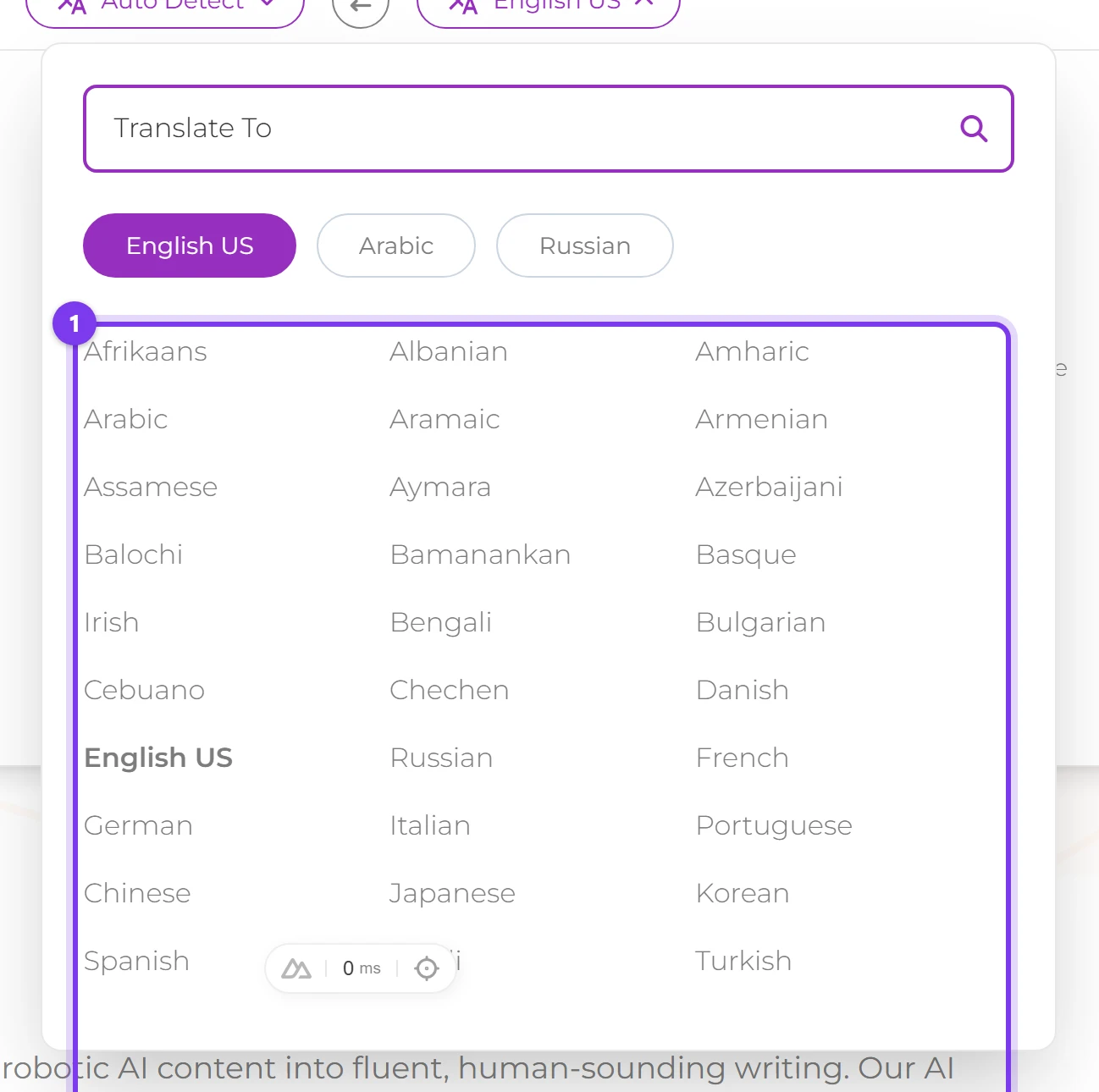
The menu scrolled to its end on 22 November 2026: 35 languages, the last of them Indonesian. No Urdu, Tamil or Tagalog. Translate
Press Translate and read the output before you judge it. Names, numbers and dates are the four things to check by eye first, because they're what a fluent wrong output keeps looking right through.
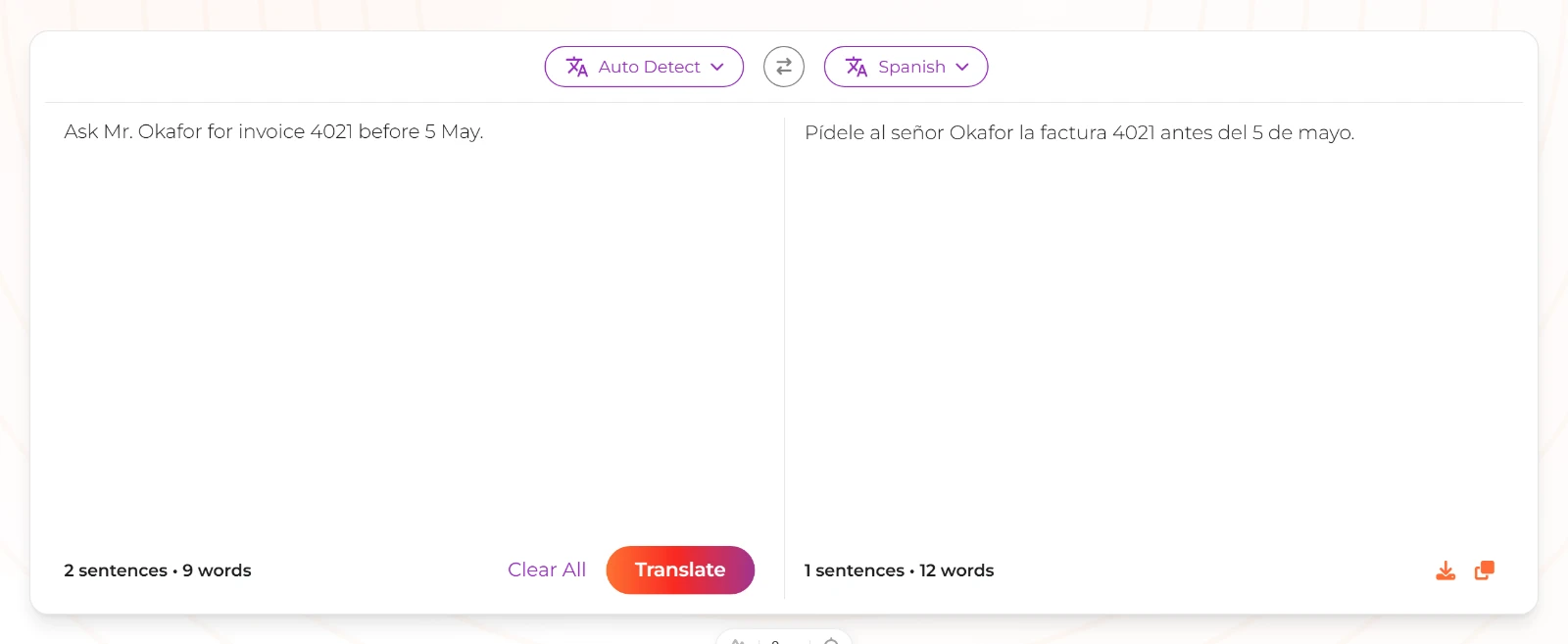
Our invoice sentence through the fusionchat.ai translator. Compare the name, the invoice number and the date with the English, token by token. Back-translate and read what changed
Reverse the pair with the swap button, paste the output back in and translate again. The swap reverses the two language codes only and moves no text, and the right-hand menu won't take Auto Detect, so set that side by hand. Clear All appears once there is output and empties both panels if you want a clean second run. Anonymous runs are capped at 10,000 tokens per tool per day, and when that runs out the page asks you to sign in.
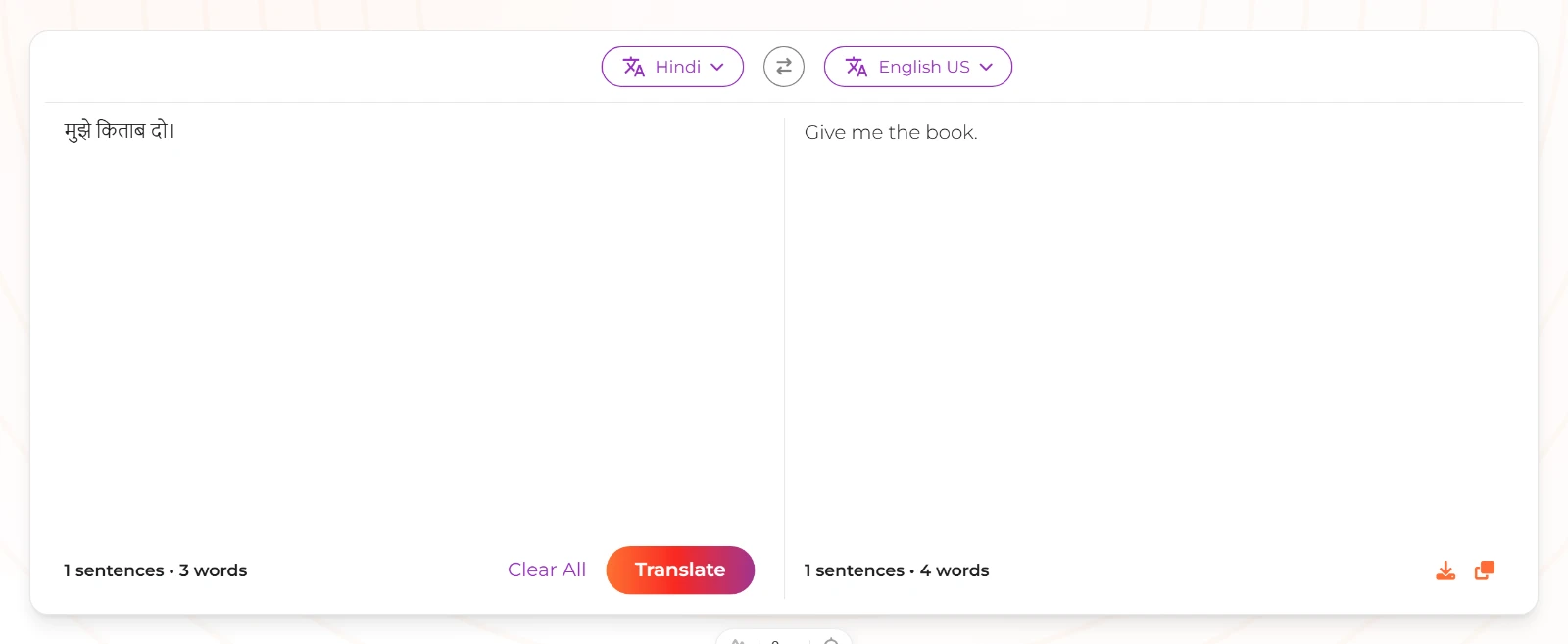
The Hindi our translator gave for Give me the book, pasted back with the two menus reversed. Read the English on the right against your own sentence, not just for sense.
What to fix in the source sentence when the output is plausible but wrong
Most bad outputs start as bad inputs, and the fixes are in your own sentence.
Name the person you're addressing. "Ask Mr. Okafor" gave the engine a relationship to work with; "ask him" gives it nothing.
Write idioms out once. If the phrase is doing work in the message, say the plain meaning in the source and let the idiom go.
Add the subject and the gender. English drops subjects comfortably and Spanish doesn't, so a missing "she" becomes a guess inside an adjective.
Spell out numbers and dates. Digits survive translation more often than words do, and "5/5" survives worst of all.
Split the sentence. Two short sentences give an engine two chances to be right; one long one gives it one chance to be wrong in a way that still reads well.
Put the politeness in the words. There's no tone or formality control on the page to set, so the courtesy has to travel in what you write.
If the meaning comes back intact and the wording still reads wrong, that's a different job from translation: How to Humanize AI Text (Without Rewriting It Yourself) is the walkthrough for that pass.
Is it safe for work email, legal, medical or money messages?
For a short factual work email, usually yes, with four things checked by eye: names, numbers, dates, and the pronoun. If a wrong tú or usted would embarrass you more than the message is worth, send it to a colleague who reads the language first.
For a contract, a medical instruction or anything that moves money, no. Not because our test found three bad Hindi sentences, but because a wrong output there is not something you can see. The page hands you plain text with a copy icon and a download icon and no send or share control, so nothing leaves without you, and that pause is worth using: put the output in front of a bilingual reader before it goes anywhere that matters. When the stakes are that shape, only a person settles it.
Try the same ten sentences yourself
The ten sentences are the ten rows of the two tables above, and every string in them is printed so you can rerun the comparison in your own pair. Take one sentence, translate it, back-translate it, and ask whether you'd have to edit the result.
Do that with one of your own sentences as well, ideally the last one you sent. The pattern to watch for is the same one we found: a kept sentence you'd send unchanged, and a plausible sentence where one token, one ending or one level of politeness is quietly wrong.
The takeaway
Treat a translator's output as a draft from a fast colleague who knows the language better than the subject: good on an ordinary sentence, worth a second look on a name, a number, a courtesy or an idiom. Check the sentence you actually have rather than the average, and back-translate it once before it goes out. If you want the rest of this cluster in one place, the more AI translator guides hub collects them.
Frequently asked questions
Is Google Translate accurate for Spanish?
How accurate is Google Translate overall, is there a percentage?
Is an AI translator more accurate than Google Translate?
How do I check a translation is accurate without speaking the language?
Is Google Translate accurate enough for a work email, a contract or a medical instruction?
Related guides
First published · Last updated : First published.