How to Use AI to Help With Homework Without Doing It
It's late, the chemistry question has three parts, and the answer you found online stops at "then balance the oxygen". Asking an AI is the obvious next move, except it hands back a finished answer to put your name on, and that's the part that gets people into trouble.
Short version: use AI for the explaining, the practice questions and the second opinion, and keep the writing for yourself. That is how to use AI to help with homework rather than do it for you: paste a prompt that names your subject, your grade level and the answer format, then check what comes back against a second method before it goes in your bag. We'll walk through it in fusionchat.ai's free AI Homework Helper.
This is for anyone with something due tomorrow and a policy they'd rather not break: one maths problem worked step by step in the answer the tool actually returned, plus the prompts and the checkpoints to hold a chemistry or history answer to, the check we run before anything goes in your bag, and what to say if a teacher asks.
What to hand to AI, and what to keep for yourself
Three jobs are worth handing over. Explaining a concept you didn't follow. Making practice questions on what's coming up in the test. Working an answer you already have a second way, to see whether the two agree. Stanford's Center for Teaching and Learning names self-quizzing and explaining an idea in your own words as the study moves that work, which is why those three are the safe ones.
The writing is the job to keep. The same guide says to assume AI isn't allowed unless your syllabus says it is, to disclose any use you do make, and that using it to substantially complete an assignment is always prohibited.
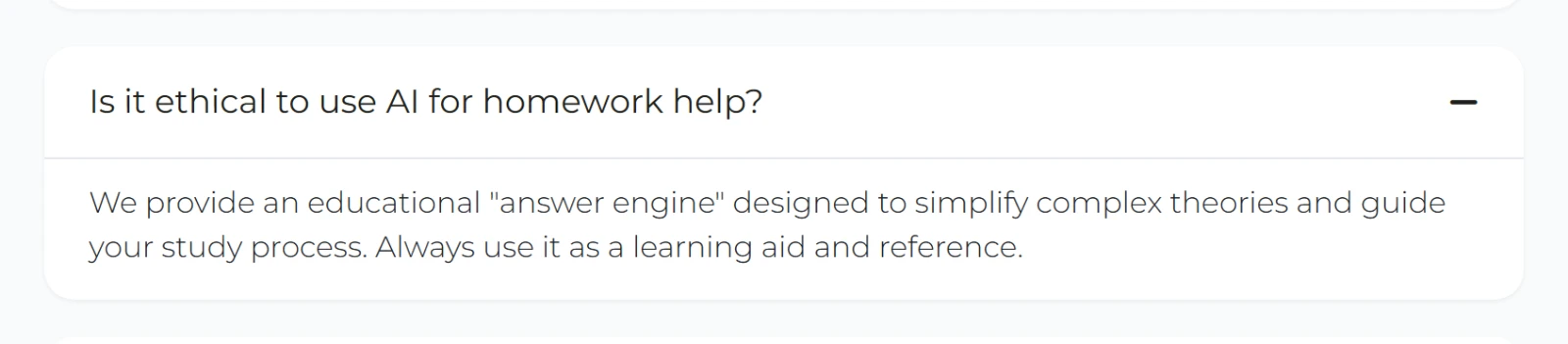
The tool's own FAQ has a heading, Is it ethical to use AI for homework help?, and the answer under it calls the tool an educational "answer engine" to be used as a learning aid and reference.
Can you get AI to do your homework for you?
Mechanically, yes. The box takes any question from 3 to 10,000 characters and hands back a finished, formatted answer. What it can't do is stand behind it: nothing re-checks the working before the answer reaches you, and it can't look anything up, so a date or a citation it gives you came out of memory. If a teacher's policy is the only thing stopping you, read that policy rather than the answer's confidence.
If the words are your own and they just need to sound like you, the guide to humanizing AI text is the better stop.
The prompt to paste: subject, grade level, answer format
The page's AI Homework Workflow runs to six stages, and the first one is three items: Homework Type and Subject, Student's Grade Level, Expected Answer Format. Those three carry most of the prompt. The fourth line is the one we'd add:
Subject: <subject and level, e.g. Grade 10 algebra (US)>
Question: <the question, copied exactly as it is written>
Answer format: <how many steps, the notation, where the final answer goes>
Show the method before the answer: <one line on how you plan to solve it, then work it through>
Ask for a result and you get a result you can't argue with. Ask for the plan first and the answer commits to a method you can follow, disagree with and repeat, which is what makes the checking later possible. The shape isn't unusual either: BBC Bitesize's templates start "I am a [Your Year] student studying [Your Subject]".
Open the AI Homework Helper
Go to the AI Homework Helper tool page. The headline says AI Homework Helper, and under it sits one box with the placeholder Type or upload your question and one button, Solve Problem. No settings to work through, no model to choose. Under Try these questions are three example cards (Solve the function, Solve the system of equations, Solve the equation), all of them maths, so leave them alone for a chemistry or history question.
Paste the four lines
Click the box and paste. Anything shorter than 3 characters or longer than 10,000 is refused, which is roomy for one question. The prompt in the screenshot below is the maths one from the next section.
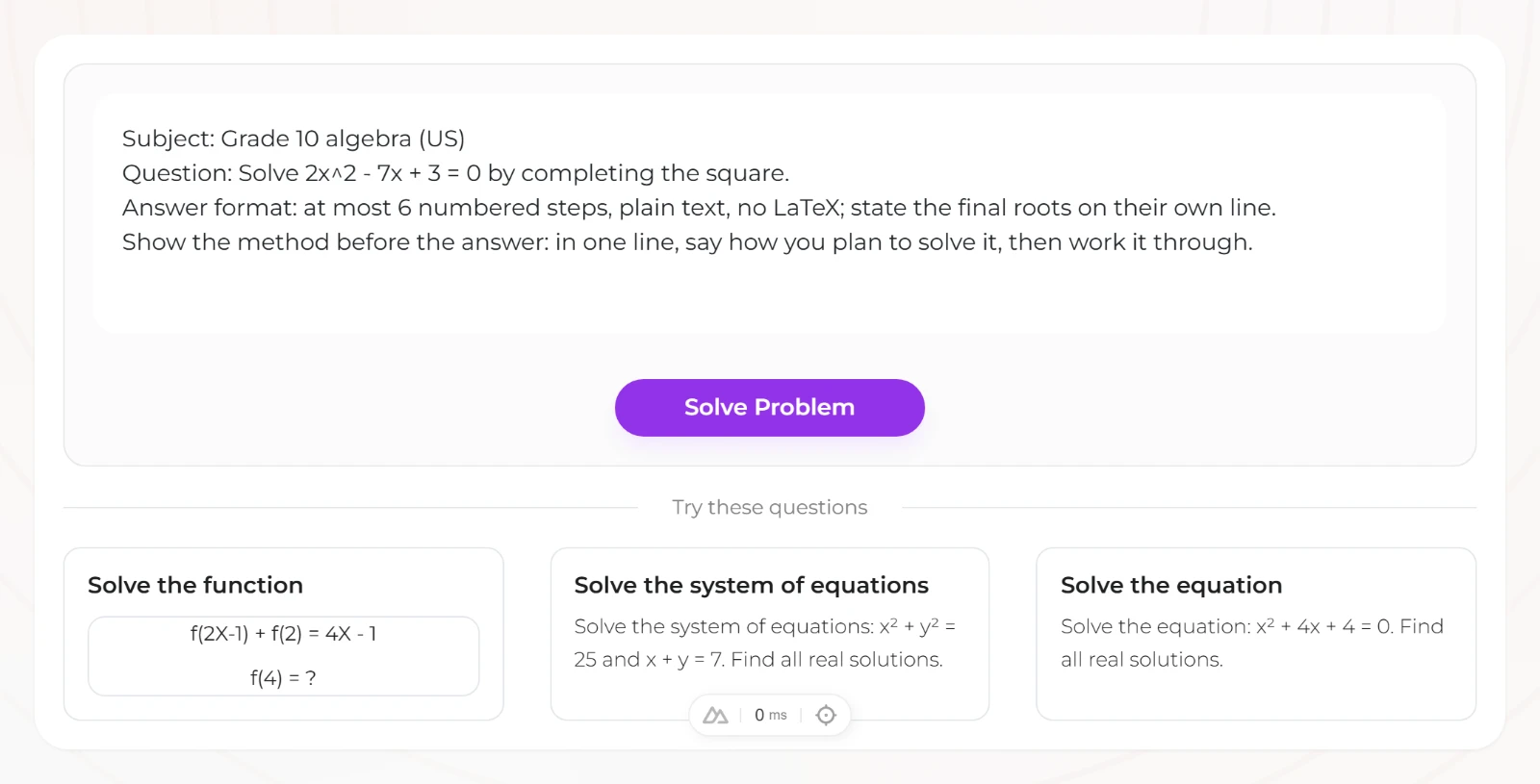
Subject, grade level, answer format, and the method asked for first. Press Solve Problem
Click Solve Problem. The button reads Solving... while the answer is being written, and then the result card replaces the box.
Worked example: a maths problem, step by step
This is the prompt in the screenshot, pasted and run on 7 November 2026:
Subject: Grade 10 algebra (US)
Question: Solve 2x^2 - 7x + 3 = 0 by completing the square.
Answer format: at most 6 numbered steps, plain text, no LaTeX; state the final roots on their own line.
Show the method before the answer: in one line, say how you plan to solve it, then work it through.
The answer comes back in a card with your question at the top, the working under the label [Solution], a retry icon, a copy icon and a button marked Enter New Problem. There's no download in that card, even though the workflow list mentions a Downloadable Report, so copy and paste is how the answer leaves the page. The maths is written in plain text (x^2, sqrt(x)) rather than as rendered symbols, which matters when you're copying it onto paper by hand.
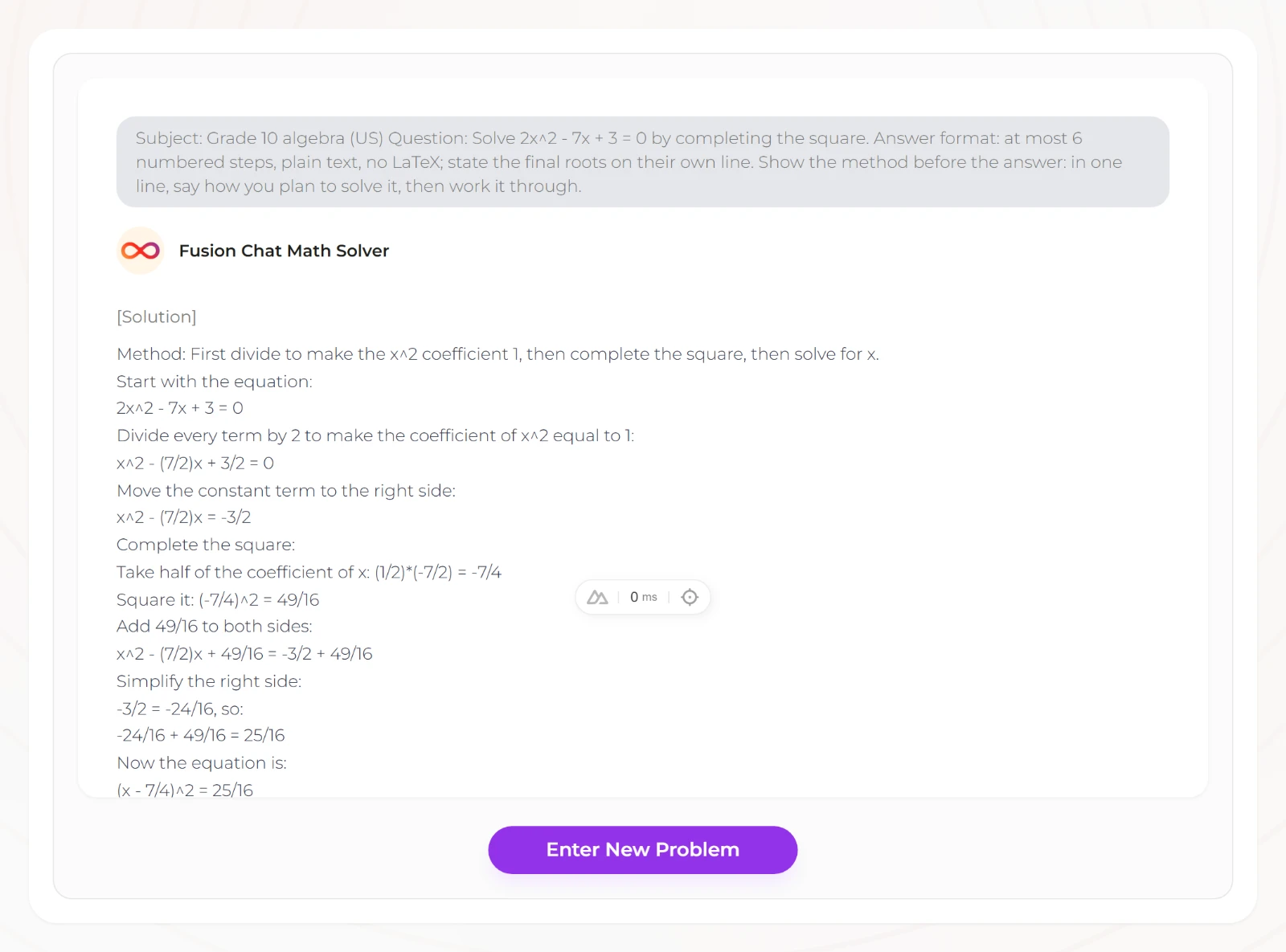
Work the problem yourself alongside the card, and hold it to these six points:
Divide both sides by 2 so the squared term stands alone: x^2 - 3.5x + 1.5 = 0.
Move the constant across: x^2 - 3.5x = -1.5.
Halve the x coefficient and square it: 1.75^2 = 3.0625, added to both sides.
Write the left side as a square: (x - 1.75)^2 = 1.5625.
Take the square root of both sides: x - 1.75 = ±1.25.
State the two roots: x = 3 and x = 0.5.
Read down from step 1, not up from the answer. A wrong step is what a wrong answer hides: if step 3 on the card disagrees with step 3 on your paper, the roots under it can't be trusted whatever they say.
Worked example: balancing a chemistry equation
Same box, same button, a different subject line. The reply isn't printed here: the maths card above is the only answer shown as it came back, and the only one we date.
Subject: GCSE Chemistry (UK, Year 11)
Question: Balance this equation and name the type of reaction:
C3H8 + O2 -> CO2 + H2O
Answer format: at most 6 numbered steps, plain text, no LaTeX; final balanced equation on its own line
Show the method before the answer: in one line, say how you plan to balance it, then work it through.
Balancing has an order to it, and the order is what an exam asks you to repeat, which is why the prompt asks for the plan first. Do the equation yourself before you paste, then read whatever comes back against these six points:
Carbon first: 3 C on the left means a 3 in front of CO2.
Hydrogen next: 8 H on the left means a 4 in front of H2O.
Oxygen last: the right side now holds 3×2 + 4×1 = 10 O, so the left needs 5 O2.
Re-count every element: C 3 and 3, H 8 and 8, O 10 and 10.
Name the reaction: propane burning in oxygen is combustion, giving carbon dioxide and water.
The line to copy: C3H8 + 5 O2 -> 3 CO2 + 4 H2O.
Point 4 is the one to do on paper even when the answer looks right, because nothing else will do it for you.
Worked example: a history or literature question, with sources
Subject: GCSE History (UK, Year 11)
Question: Explain two causes of the 1929 Wall Street Crash in the United States.
Answer format: two paragraphs, at most 6 sentences each, plain text; name the dates you use.
Show the method before the answer: one line on how you will split the two causes, then write them.
Then list every source you would cite, so I can check each one exists.
That last line isn't politeness. The tool can't search, so every source it names comes from memory, and an invented citation looks exactly like a real one. Getting the names in one list is what makes them checkable in one sitting.
Work your two causes out first, then hold the reply to these four points:
Two causes kept apart: shares bought on credit, and a market with no effective regulator to cap that credit.
The dates that carry the argument: 24 October 1929, when margin calls forced selling, and 29 October 1929, the heaviest day of the fall.
Each paragraph follows one cause through to falling prices instead of listing events.
No source is taken on trust: look every name up before it reaches a bibliography.
A literature question takes the same shape. Ask for the method, then ask for the passages it is quoting, because a quotation it recalls and a quotation in your book are not the same thing.
How to check the answer before you hand it in
Nothing checks the answer but you. The check is three moves, and all three are yours.
Ask the same question a second way
Click Enter New Problem to get the box back, then paste the question again with the method forced: "Solve 2x^2 - 7x + 3 = 0 by factoring instead, at most 4 steps, then say which method is shorter and why."
Re-derive the final value yourself
Both runs have to land on the same numbers, which for the example above means x = 3 and x = 0.5. When they disagree, one of the two is wrong and neither belongs in the bag yet.
Quiz yourself with the tab closed
Write the six steps from memory and compare them with the card. Self-quizzing is one of the study moves the Stanford guide singles out, and it's the only part of this routine that leaves anything in your head, which makes it the part of studying with AI worth keeping once the deadline pressure is off.
When the answer is wrong
Two failures are worth knowing, because they need different responses.
The run fails outright and the page says An error occurred while solving the problem. Send it once more; if it fails again, cut the prompt down to the question and the format.
The answer comes back plausible and wrong. A mis-signed term or an invented date reads like every other answer, and BBC Bitesize warns its students about exactly that: AI can make up facts, sources and dates. Don't re-run the same prompt and hope. Go back to your checkpoints, find the first step that disagrees, and re-prompt naming the method you want, such as "solve by completing the square and show the halving step explicitly".
If your teacher asks whether you used AI
Answer with what you used it for, not with whether you used it: "I used it to check my working and to make practice questions. Here's my working, and here's the second method I tried." That's true, checkable, and it's what the policies actually ask you to disclose.
Stanford's guide says to assume AI isn't allowed unless the syllabus says it is, and to disclose any use you make. BBC Bitesize tells students to ask their teacher before using it at all, and lists a zero for the assignment or disqualification among the penalties.
Every guide we publish for this tool is collected in the AI Homework Helper guides hub.
Try it on the question you got wrong last week
Take the one question from last week you never fully followed, paste it with your subject, your level and the answer format, and ask for the method before the answer. Then do the second-method run and the quiz from memory with the tab closed. The point isn't the answer it gives you; it's the working you can reproduce when the tab isn't open.
Frequently asked questions
Is it ok to use AI for homework?
What prompt should I paste into an AI homework helper?
Can AI do my homework for me?
How do I check an AI answer before I hand it in?
What do I say if my teacher asks whether I used AI?
First published · Last updated : First published.