How to solve absolute value equations: both cases, checked
You've solved |3x + 2| = 4x + 5 twice now, got x = −3 and then x = −1, and both lines looked clean. Only one of those is an answer. The other one is the algebra handing you a number the equation never had, and it sits there looking correct until you test it.
Short version: every method for how to solve absolute value equations comes down to the same fact, that |A| is the distance from A to zero on the number line, and distance runs in two directions. Get the bars alone on one side, write what's inside them equal to the right side and then equal to its negative, solve both, and substitute each answer back into the original. The substitution is what decides between a real answer and a manufactured one.
The rest of this post walks |3x + 2| = 4x + 5 through all of that, uses |3x + 8| + 5 = 2 for the equation with no answer at all, and ends by typing your own equation into a free solver and asking for both cases. It's for anyone meeting this in algebra 2, a placement test, or a precalc re-take, where the working and the check are where the marks live.
Why an absolute value equation is two equations
|A| measures distance: how far A sits from zero on the number line, with no sign attached. |5| is 5 and |−5| is 5, because both are five steps from zero, one to the right and one to the left.
Read |x − 3| = 5 with that in mind. Whatever x − 3 is, it sits five steps from zero, so it is either 5 or it is −5:
x − 3 = 5 gives x = 8
x − 3 = −5 gives x = −2
Both hold in the original: |8 − 3| = 5, and |−2 − 3| = |−5| = 5. Two answers, and neither is a mistake.
The word joining the cases is "or", never "and". x = 8 and x = −2 can't both be true of the same x; the solution set is the two of them together. Writing "and" is how an answer ends up reading like a contradiction, or loses half its marks.
So the split isn't a rule someone invented for the test. It comes out of the definition, and it will keep coming out the same way on every equation of this type you meet.
Solving absolute value equations: isolate the bars first
The two-case rule is a rule about |A| = c, with the bars alone on one side. Anything outside the bars moves first: add or subtract the loose number, then divide by whatever is multiplied against them.
2|3x + 8| − 1 = 13 in that order:
Add 1: 2|3x + 8| = 14
Divide by 2: |3x + 8| = 7
Split: 3x + 8 = 7 gives x = −1/3, and 3x + 8 = −7 gives x = −5
Check both: |3(−1/3) + 8| = |−1 + 8| = 7, and |3(−5) + 8| = |−7| = 7. When the right side ends up as a plain positive number, the split is safe and both answers are real.
Skipping the isolation is where most of the damage happens. On |3x + 8| + 5 = 2 nothing outside the bars looks complicated, so people split immediately and get a mess. Subtract the 5 first and the line reads |3x + 8| = −3, which is not an equation to split. It's a statement about distance, and a negative one.
How to set up case 1 and case 2
Take |2x − 5| = 9, with the bars already alone.
Case 1: the inside equals the right side.
2x − 5 = 9
2x = 14
x = 7
Case 2: the inside equals the negative of the right side.
2x − 5 = −9
2x = −4
x = −2
Then check both in the original: |2(7) − 5| = |9| = 9, and |2(−2) − 5| = |−9| = 9. Both pass, which is the normal result for a right side that has no x in it.
Case 2 is where the arithmetic goes wrong most often, and always in the same spot: the minus has to hit every term inside the brackets. −(4x + 5) is −4x − 5, not −4x + 5. Write that line out and simplify it before moving anything across, rather than doing it in your head.
Keep the cases numbered and separate on paper, and keep each answer next to the case that produced it. When one of them fails the check further down, you want to know which case to distrust. If the two are tangled together, you only know that something went wrong somewhere.
Absolute value equations with no solution, and the case with one answer
|3x + 8| = −3 asks which x puts 3x + 8 exactly three units from zero, in the negative direction. There's no such distance. The equation has no solution, and the empty set symbol ∅ is the standard way to write that if your course uses symbols.
Don't force a split on it. Doing so gives 3x + 8 = −3, so x = −11/3, and 3x + 8 = 3, so x = −5/3. Put either back and it falls apart: |3(−11/3) + 8| + 5 = |−3| + 5 = 8, and 8 is not 2. The algebra produced two numbers that satisfy nothing.
Zero is the quiet version of the same idea. |x − 4| = 0 splits into x − 4 = 0 and x − 4 = −0, and −0 is 0, so both cases are the same equation. One solution, x = 4. Whenever the right side is 0, the two cases collapse into one, and writing "two solutions" is the mistake to avoid.
Absolute value equations with extraneous solutions: |3x + 2| = 4x + 5
Now the right side carries an x, and that changes what a solution is allowed to be.
Case 1: 3x + 2 = 4x + 5, so x = −3.
Case 2: 3x + 2 = −(4x + 5), so 3x + 2 = −4x − 5, so 7x = −7, so x = −1.
Both look finished. Test them in the equation as it was written:
x = −3: left side |3(−3) + 2| = |−7| = 7, right side 4(−3) + 5 = −7. 7 ≠ −7, so x = −3 is extraneous.
x = −1: left side |3(−1) + 2| = |−1| = 1, right side 4(−1) + 5 = 1. Equal, so x = −1 is a solution.
The only answer is x = −1, and what killed the other one is visible before you substitute anything. An absolute value is never negative, so the side without bars has to be at least zero. Here that means 4x + 5 ≥ 0, so x ≥ −5/4, and −3 never qualified. That inequality is a fast way to reject a case. The substitution is what shows the working.
With a plain number on the right, an extraneous answer can't happen and the check is a courtesy. With an x on the right, the check is the method. Same four moves every time, and the last one is not optional.
Your own equation: a free absolute value equation calculator with steps
The math solver ai page is where the arithmetic stops being the point. It's a free math solver with steps, and it takes text rather than symbols alone, so the instruction you'd give a tutor in person (do both cases, then check them) can go in the same box as the equation.
Open the solver
The page is one box with the placeholder Type or upload your question and one button reading Solve Problem, which sits dimmed until there's text in the box. Ignore the word upload: there's no upload control on the page, so a photo of an equation has to be typed in.
Type the equation and ask for the check
For this post's equation, type: Solve |3x + 2| = 4x + 5. Show case 1 and case 2 as separate equations and check each answer by substitution. The box takes anything from 3 to 10,000 characters, so there's room for the equation and the request together.
Asking for the check is the part most people leave out, and it's what separates a working you can hand in from a list of numbers. It's also the step that exposes an extraneous answer.
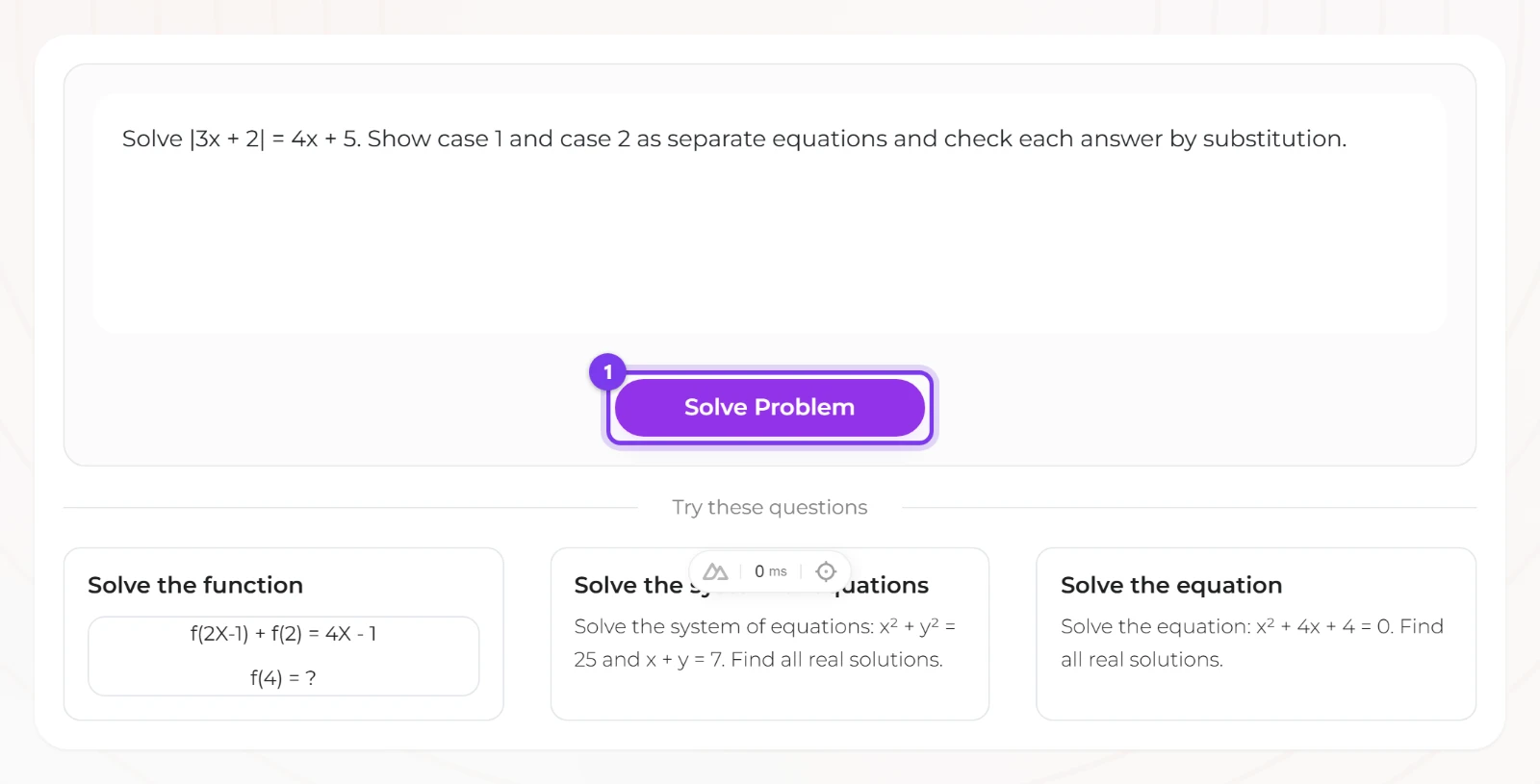
The equation and the check you want, in one box. Select Solve Problem and read both cases
Solve Problem is the only thing that submits; pressing Enter in the box just adds a line break. While it's working, the button and the card both read Solving...
What comes back repeats your request in a grey bubble, signs itself Fusion Chat Math Solver, labels the working [Solution], and ends with an Enter New Problem button. The working is plain text, with powers as x^2 and roots as sqrt(x) rather than LaTeX, so it stays readable on a phone.
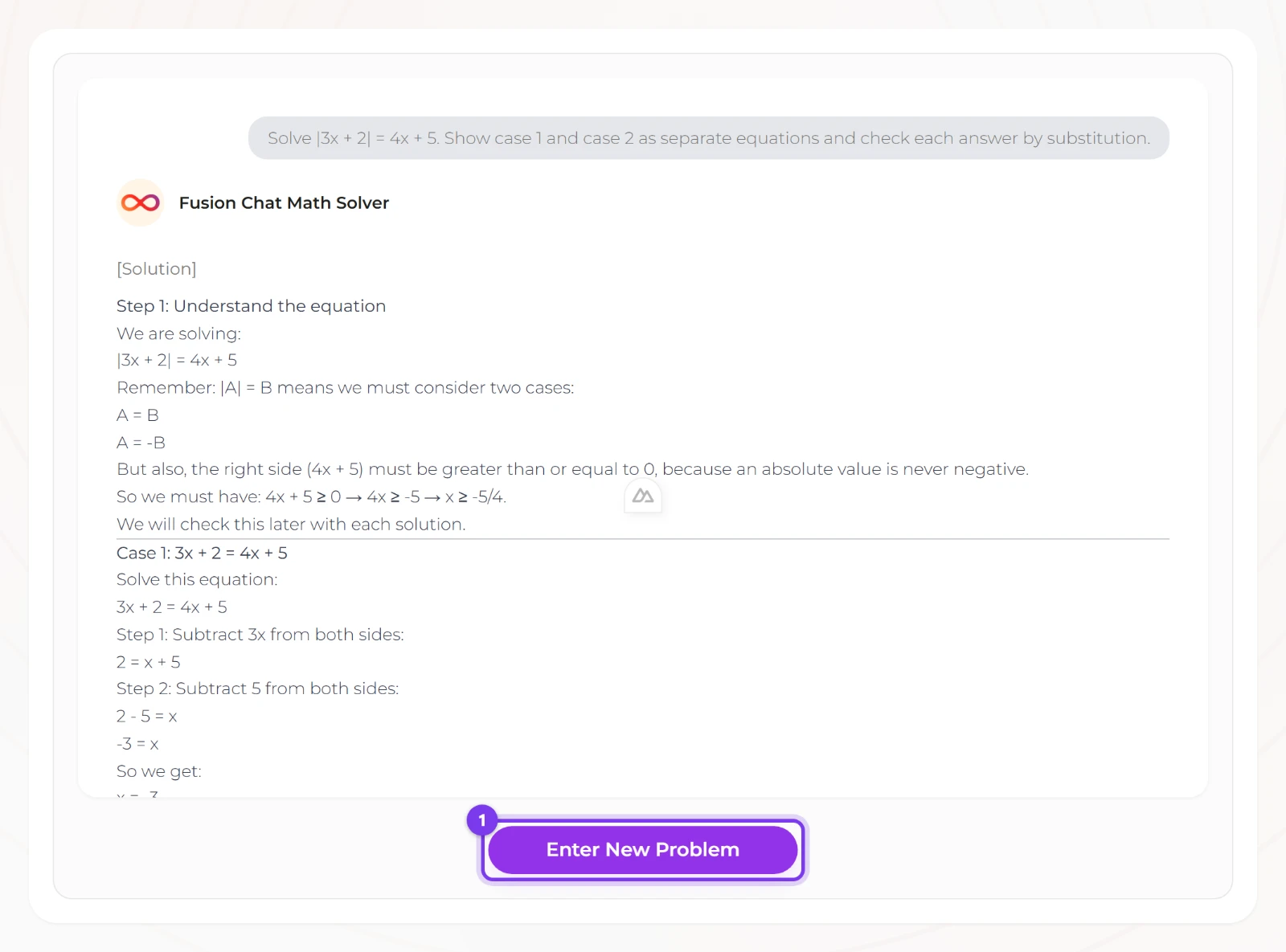
The working comes back under [Solution], ending in Enter New Problem. Read the working in the order you'd have written it yourself: case 1, case 2, then the substitutions. If the check lines aren't there, the re-run icon on the card sends the same question again, so add "check each answer by substitution" and run it a second time.
Run the equation that has no answer
Press Enter New Problem and put in Solve |3x + 8| + 5 = 2, asking for the isolation step and whether the equation has a solution. Compare the reply with the section above: the isolated line should read |3x + 8| = −3, and there's nothing left after it to split. If the reply jumps straight to values of x, the request was too vague, so say what happened to the right side.
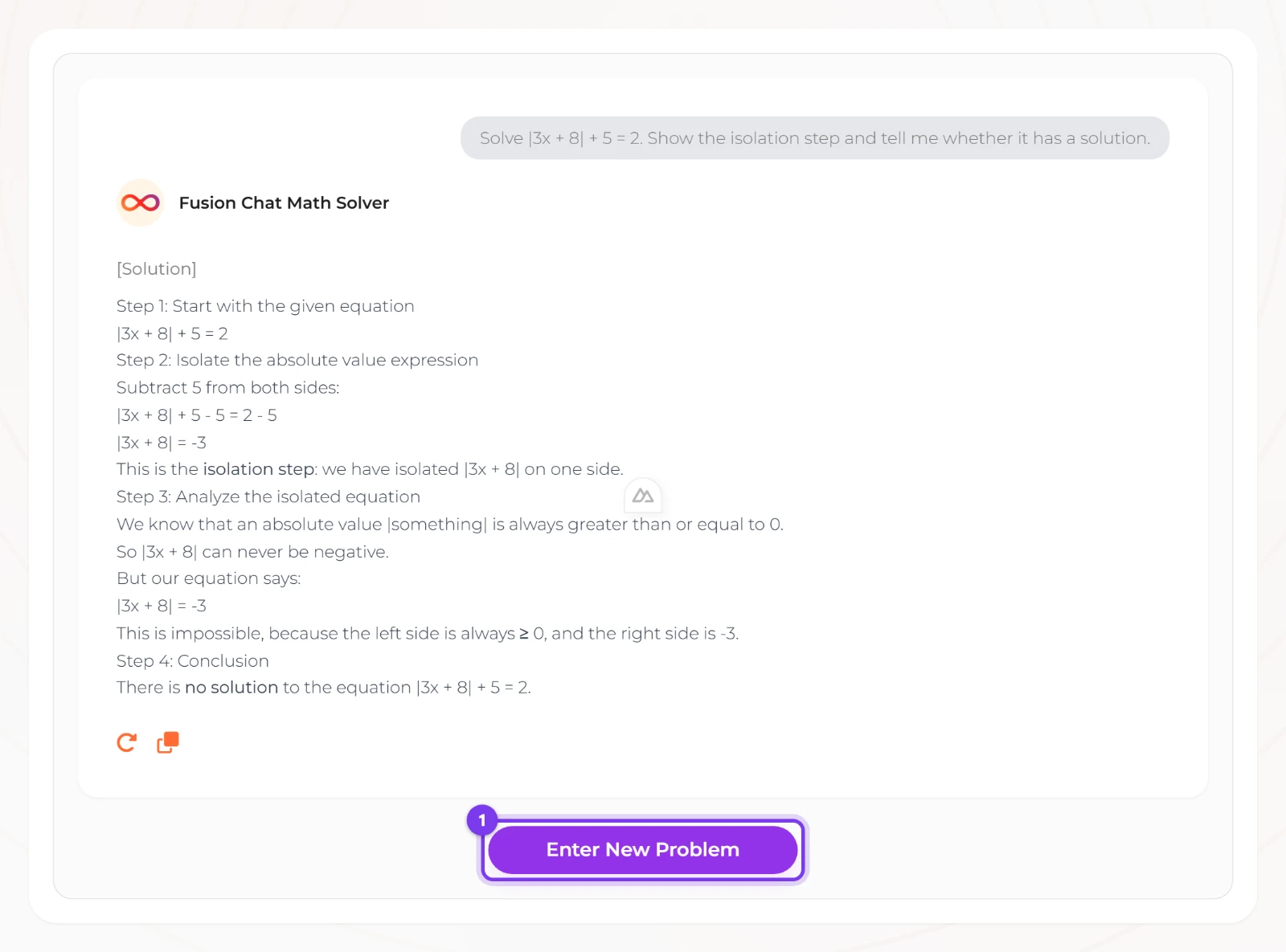
The equation that isolates to a negative distance.
What the other pages leave you to do
MathPapa will solve the equation and won't show the working unless you pay. The step-by-step button opens a Premium upsell with a counter reading "(1 more today)", and the explanation you get without it is two bullets, the first of which reads "Get the absolve value expression by itself."
MathBitsNotebook gets further than most. Its chapter works the no-solution case, writing "The answer is the empty set Ø", and works the extraneous case on |3x + 2| = 4x + 5, dropping x = −3 and keeping x = −1. What it doesn't offer is a place to put your own equation, and it closes by suggesting your graphing calculator for the checking.
Purplemath is three pages of hand-written lesson with no tool at the end of it, and on one of its last examples it says "The exercise doesn't tell me to check, so I won't". That's honest about the exercise and not much use in an exam, where nothing tells you to check either.
None of this is a reason to skip the reading. The explanations on those pages are better than a one-line answer. They just leave the last step, checking your own equation, to you.
The takeaway: isolate, split, check
Get the bars alone, write the two cases, substitute both answers. The first two moves are mechanical and the third is where the marks are, which is why "no solution" and "extraneous" are the same habit seen from two directions.
Before you touch the solver, do |2x − 7| = 3x + 1 by hand and see which of your two answers survives, then compare the working with what you get back. If an x² appears once the bars come off, how to solve quadratic equations takes over from there, and there are more math solver guides on the topic hub when you want another worked example.
Frequently asked questions
Why does an absolute value equation split into two cases?
How do I isolate the absolute value before splitting?
How do I set up case 1 and case 2?
What does a negative right side mean, and what if it's zero?
How do I catch an extraneous solution?
Can I put an absolute value equation into the math solver?
Related guides
First published · Last updated : First published.