How to Add Fractions: Work Your Own Sum, Step by Step

You're halfway through the worksheet on how to add fractions and the next line is 3/4 + 5/6. The tops are easy, 3 + 5 = 8, except that's the wrong answer: the bottoms don't match and nobody said which number you're allowed to change. The teacher collects in the morning.
Short version: you can only add top numbers once the pieces are the same size. Rewrite both fractions over a common denominator, add the numerators, keep the denominator, then simplify. Every sum below is worked on that same 3/4 + 5/6, plus one with mixed numbers, so you can follow a single problem to the end instead of three textbook ones.
The first five sections are the rules. The last one runs a sum of your own through the fusionchat.ai AI Homework Helper and then asks for the same answer a second way as a check. It's for the person working the worksheet tonight, not the person teaching it.
How do you add fractions with the same denominator?
The denominator is the size of the piece; the numerator is how many pieces you have. When the sizes already match there's nothing to convert: add the numerators and keep the denominator.
3/8 + 1/8 = (3 + 1)/8 = 4/8 = 1/2.
The 8 never moved. If a same-denominator answer comes out over a different denominator, you added something you weren't supposed to, so start again.
One more, with a simplification at the end: 5/12 + 3/12 = 8/12, and 8 and 12 both divide by 4, so the answer is 2/3.
How do you add fractions with different denominators — and when do you use the least common denominator?
You can't add 4ths to 6ths as they stand, because the pieces are different sizes. The fix is to cut both into smaller, matching pieces: rewrite each fraction over the same denominator, then add the numerators.
For 3/4 + 5/6, the smallest number both 4 and 6 divide into is 12. So 3/4 = 9/12 and 5/6 = 10/12, and 9/12 + 10/12 = 19/12, which is 1 7/12 as a mixed number.
That's how to add fractions with different denominators in one pass. The other route works every time: multiply the two denominators for the new bottom, and cross-multiply for the top.
(3 × 6 + 5 × 4) / (4 × 6) = (18 + 20)/24 = 38/24 = 19/12.
Same answer, bigger numbers, and that's the trade. Multiplying the bottoms never fails, but it inflates the fractions, so 38/24 needed a division by 2 before it became the 19/12 the least common denominator would have handed you straight away. When the two bottoms share a factor, as 4 and 6 do (both divide by 2), the least common denominator is the shorter road. When they share none, like 3 and 5 or 4 and 7, the least common denominator is just the product and both routes cost the same.
Some worksheets say unlike denominators instead of different ones. Same instruction, same steps.
How do you add mixed numbers and improper fractions?
Mixed numbers are the ones with a whole number in front, like 2 1/3. Convert each one to an improper fraction first (multiply the whole number by the denominator, then add the numerator), add them as above, then convert back.
2 1/3 = (2 × 3 + 1)/3 = 7/3 1 3/4 = (1 × 4 + 3)/4 = 7/4 7/3 + 7/4 = 28/12 + 21/12 = 49/12
49 ÷ 12 = 4 remainder 1, so 49/12 = 4 1/12.
The trap is stopping too early. If you add the whole parts and the fraction parts separately, the fraction part can overflow into another whole: 2 + 1 = 3, and 1/3 + 3/4 = 4/12 + 9/12 = 13/12 = 1 1/12, so the total is 3 + 1 1/12 = 4 1/12, not 3 13/12.
How do you simplify the answer with the greatest common factor?
A fraction is in lowest terms when the top and bottom share no factor except 1. The greatest common factor is the largest number that divides both, and dividing by it once finishes the job.
4/8: the factors of 4 are 1, 2, 4, and the factors of 8 are 1, 2, 4, 8. The largest shared one is 4, so 4/8 = 1/2.
38/24: both are even, so the greatest common factor is at least 2, and 19 and 12 share nothing else, so 38/24 = 19/12.
If the numbers are awkward, simplify in stages instead: halve both, halve again, then try 3s and 5s. You land in the same place with more moves.
Then check the form. 19/12 is a perfectly good improper fraction, but if the question was given in mixed numbers the answer usually has to be one: 19 ÷ 12 = 1 remainder 7, so 1 7/12. Lowest terms in the right form is what counts as finished.
How do you catch the "added the bottoms too" error and check the answer before you hand it in?
The error from the top of this post is 1/2 + 1/3 written as 2/5. It looks tidy and it's wrong, because the bottoms aren't quantities to add; they describe the size of the pieces.
The quickest way to see it is decimals. 1/2 = 0.5 and 1/3 ≈ 0.33, so the answer has to be bigger than 0.5. And 2/5 = 0.4, which is smaller than the 1/2 you started with. Adding two positive fractions can't give a total smaller than the larger addend, so 2/5 fails on that test alone. Done properly: 3/6 + 2/6 = 5/6.
Three checks, in the order you'd do them at a desk:
Bigger than the biggest. Is the answer larger than the larger addend? 19/12 ≈ 1.58 beats 5/6 ≈ 0.83, so that one passes. If it doesn't, the bottoms went into the sum.
Decimals. 3/4 = 0.75 and 5/6 ≈ 0.83, so the total should be about 1.58, and 19/12 = 1.583. The test is for 2/5-type errors, not for rounding.
Subtract an addend back out. Take the answer and remove one addend: 19/12 − 9/12 = 10/12, which is 5/6, the other addend. Subtraction reverses the sum, so this check almost never lies.
For mixed numbers there's a fourth: add the whole parts and the fraction parts separately, as in the previous section, and see whether you land on the same total.
An answer on a screen isn't a mark on your page. Copy the working, run the checks against your own paper, and hand in the version you can defend.
How do you get a step-by-step answer to your own fraction question from the AI Homework Helper?
Everything above is arithmetic you can do on paper. When you want a second opinion on your own sum, the AI Homework Helper is the fusionchat.ai tool for it: you type the question and the answer comes back in steps.
Open the AI Homework Helper
Open the AI Homework Helper; no account is needed to use it.
The box is labelled Type or upload your question, but there's no upload button anywhere on the page, so type the sum in yourself. Ignore Try these questions too: its three examples are a function, a system of equations and a quadratic, and none of them is a fraction.
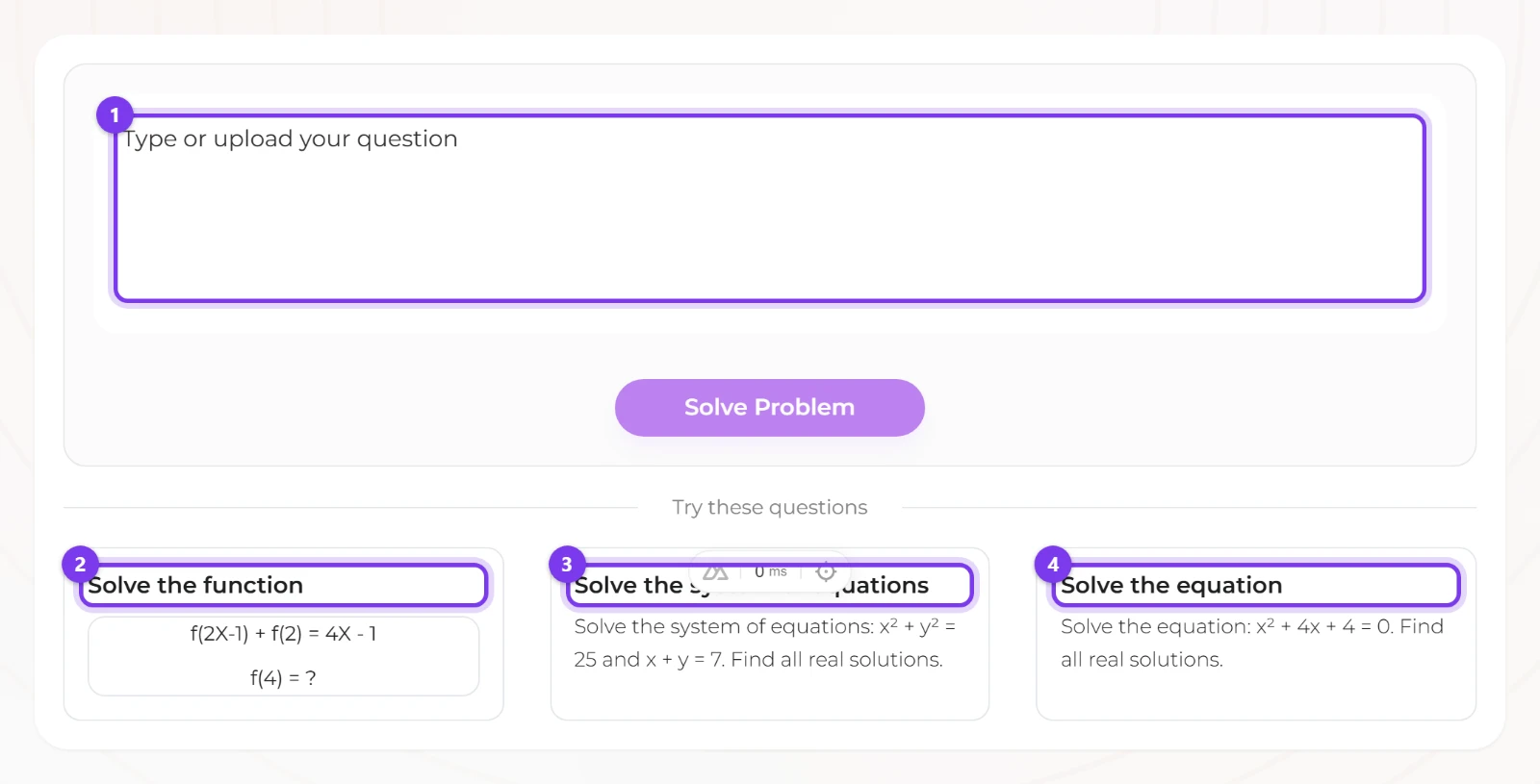
Your own sum goes in the box; the three examples are not fractions. Type the sum out in full
Send a complete question rather than bare numbers. We'd type: "Add 3/4 + 5/6 using the least common denominator. Keep it brief: one short line per step, no introduction, and end with the answer as a mixed number."
One line per step is worth asking for: it's easier to line up against your own paper.
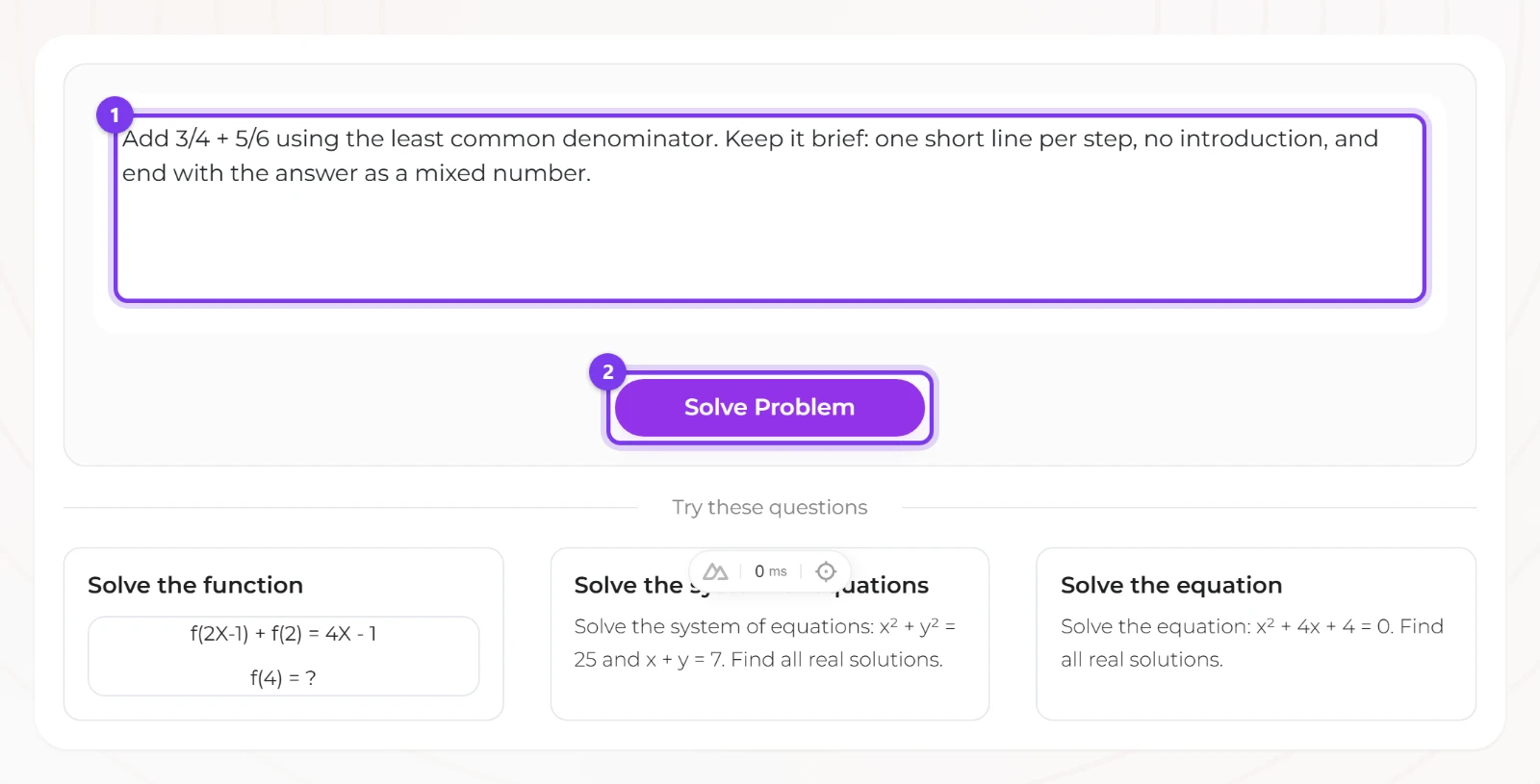
The whole question typed out, with Solve Problem now enabled. Press Solve Problem
The button reads Solve Problem and stays disabled until there's text in the box; while it works it reads Solving.... The input card is then replaced by the answer: your own question in a grey bubble, the header Fusion Chat Math Solver, and the label [Solution] above the working.
Read the middle of the answer, not just the last line. The step that rewrites both fractions over 12 is where a slip in your own paper usually shows up.
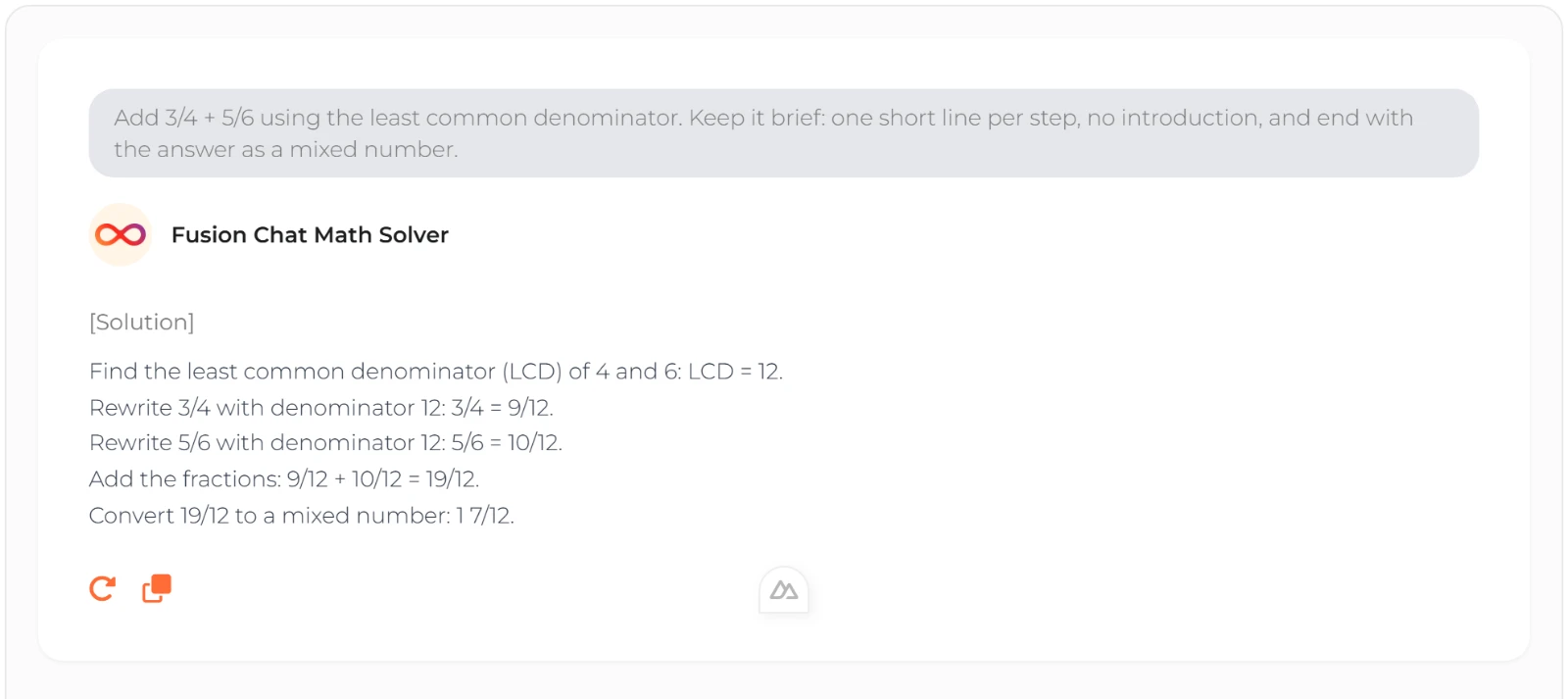
The working for 3/4 + 5/6 ends at 19/12 = 1 7/12. Ask about mixed numbers
Press Enter New Problem to clear the answer and get the input box back, then type: "Add 2 1/3 + 1 3/4 by converting both mixed numbers to improper fractions. Keep it brief: one short line per step and end with the answer as a mixed number."
The answer arrives as formatted text with the working broken into steps, so you can compare it line by line against your paper.
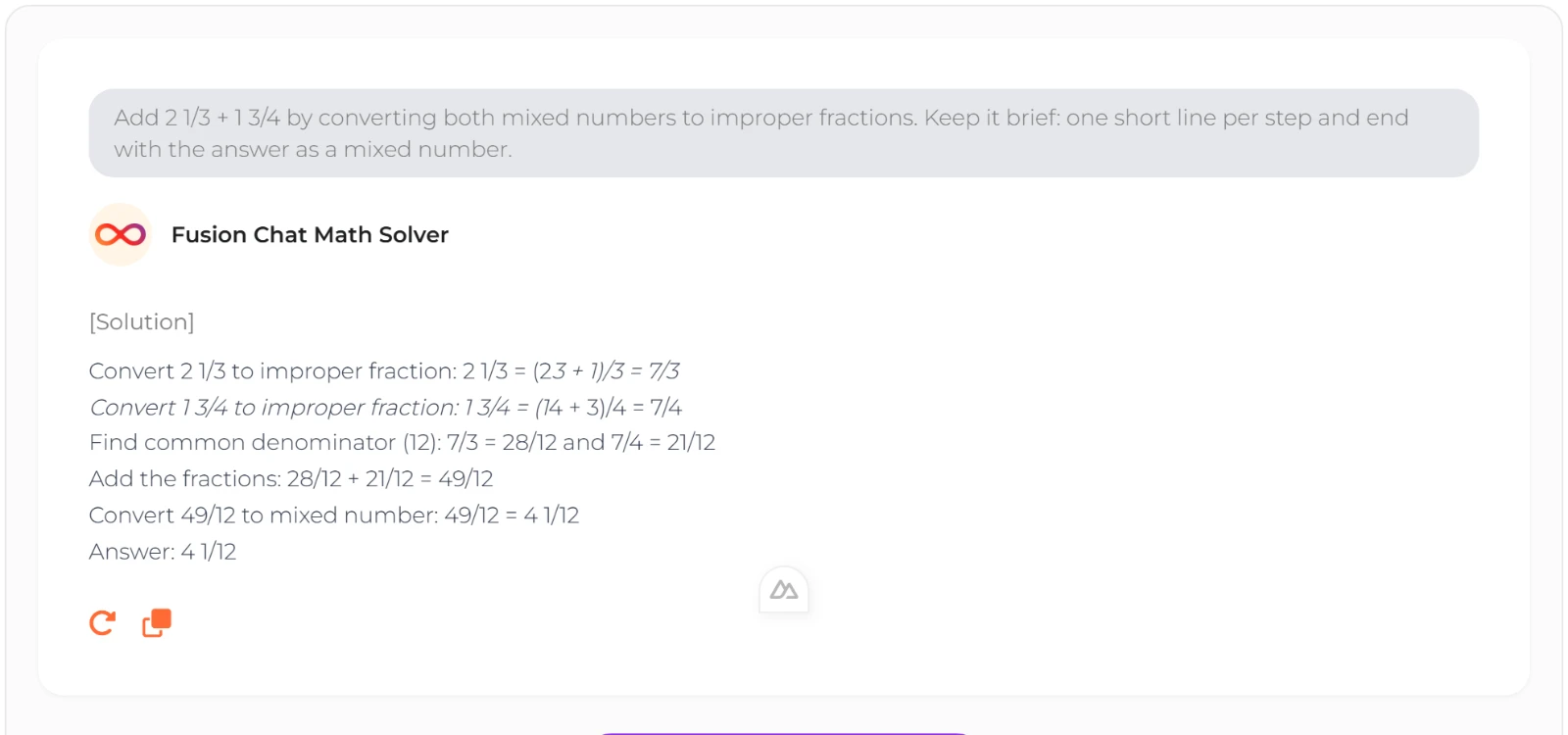
Mixed numbers the same way: 49/12 = 4 1/12. Check the answer before you use it
Put the returned working through the three checks above: bigger than the biggest addend, decimals, and one addend subtracted back out.
Two of the buttons under an answer make that easier. The copy icon copies the whole answer as plain text, so you can set it beside your paper. The circular arrow re-sends the same question word for word, which is a second attempt rather than a second method.
Ask the same sum a different way
For an independent check, ask for the long route. Press Enter New Problem and type: "Add 3/4 + 5/6 again, multiplying the denominators instead of using the least common denominator. Keep it brief: one short line per step, then simplify."
You're looking for 38/24 before it reduces to 19/12: the same value from a different route. When two methods agree on the lowest-terms answer, a shared slip is unlikely.
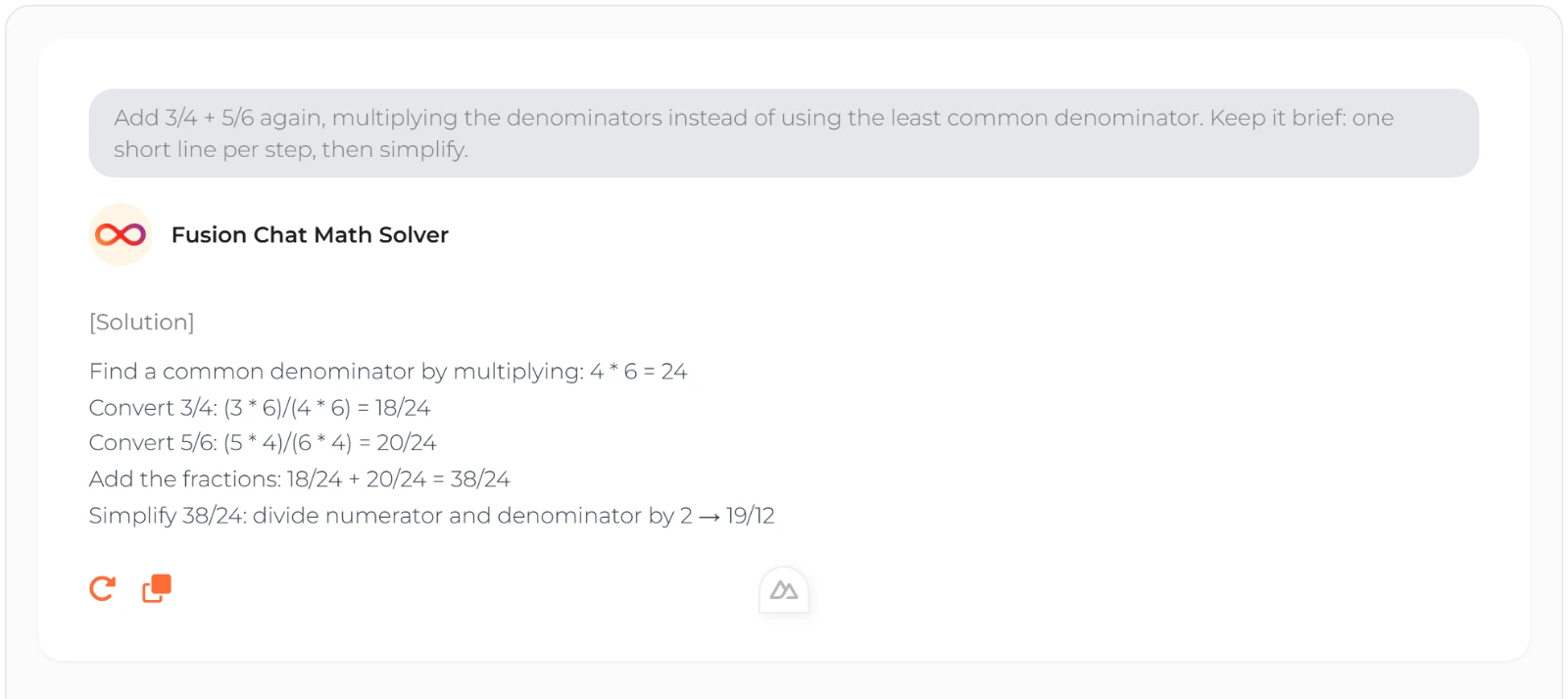
The same sum the long way: 38/24 = 19/12.
What to do tonight
Take one sum off tonight's worksheet, type it the way we typed 3/4 + 5/6, and put the answer through the three checks instead of trusting it on sight. If the working and your paper disagree, ask the same question the long way: the route you didn't take is the quickest way to find the line where you slipped. There's more AI Homework Helper guides on the blog, and how to use AI to help with homework without doing it covers the line between a helper and a shortcut. When a later question needs the arithmetic handled rather than explained, Math Solver is the sibling page for it.
Frequently asked questions
Do you add the denominators when you add fractions?
Do you always need the least common denominator?
Can you add two mixed numbers without converting them?
How do you know when a fraction is fully simplified?
How do you add three fractions in one sum?
What does the answer from the AI Homework Helper look like?
Related guides

First published · Last updated : First published.