How to Build Powerful Generative AI Solutions: A Step-by-Step Guide
There is no denying the fact that ChatGPT is a revolutionary innovation in the field of AI. It brought the generative AI solution among us, which possesses next-gen machine learning capability. Since ChatGPT is good at a lot of things, such as coding computer programs, checking bugs in code, creating content, writing video scripts, etc., companies are eager to apply GenAI at work. In the US itself, more than 35% of professionals from the marketing and advertising fields have used GenAI in their work. Not just that! The GenAI market is predicted to grow from USD 11 billion in 2020 to almost USD 128 billion in 2024 and over USD 1.3 trillion in 2032.
AI Solutions in the Market
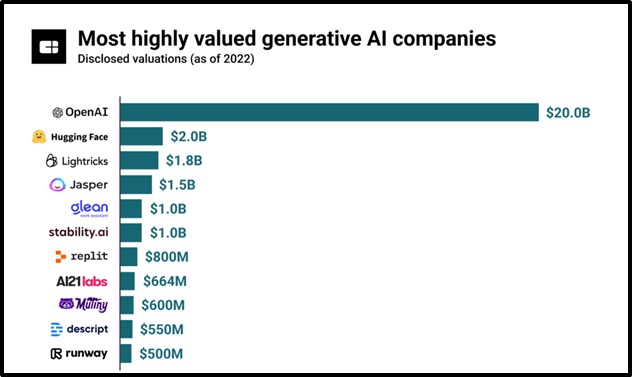
Most generative AI companies have made substantial inroads into the world of venture capital, acquiring considerably huge funding and higher valuation. For instance, an AI content platform, Jasper made a tranche of $125 million at a $1.5 billion valuation. In a similar context, Inflection AI (spearheaded by LinkedIn and DeepMind co-founders) made a whopping amount of $225M in equity financing.
In another example of similar revenue performance by using generative AI, OpenAI received billions more dollars (around $13 billion) from Microsoft, an extended partnership between the two companies. Earlier, in 2019, Microsoft invested $1 billion in OpenAI. In another report, generative AI is expected to grow by 188.62 billion by 2032 from its earlier prediction of $8.65B in 2022, thereby growing at a CAGR of 36.10% during the forecast period. And guess what – OpenAI ranked top as the most valued generative AI company, as of 2022.
Understanding Generative AI
Generative AI or generative artificial intelligence is one of the most cutting-edge technologies designed to create various types of content in response to prompts. The technology is capable of creating content like text, audio, video, imagery, and synthetic data. It comes equipped with advanced user interfaces, facilitating the creation of high-quality graphics and video in seconds. Generative AI models are scripting new definitions of success for businesses, helping them witness transformative impacts on their creativity and productivity. Technology helps businesses reinvent the way they work.
Working Mechanism of Generative AI
The working mechanism of generative AI is entirely based on how comprehensively it has gone through training processes in huge datasets. For instance, just as we teach kids how to recognize an image of someone or something through its textual and visual interpretation, generative AI goes through a similar type of training or reading process, albeit in different ways.
For example, it is taught using examples to become smart enough to create something entirely new based on the examples or data. The catch is, that most of what we witness these days in AI is the handiwork of machine learning. It empowers computer systems with the ability to learn from examples, also known as neural networks (machines that are programmed to learn from examples).
Just as any software development process requires prototyping each phase of the development process, creating a generative AI solution also requires a preliminary version of the AI solution or prototyping. It is important to allow testing of the AI solution’s feasibility and functionality.
Data Collection and Algorithm Selection
Building a generative AI solution in the prototyping stage of the development process requires data collection to ensure training and testing of the model later.
Consider The Following When Collecting Data:
In this stage of prototyping a generative AI solution, data is processed to ensure its quality, relevancy, and consistency.
Here are some steps to follow in this context –
- Appropriate generative AI algorithms for building a generative AI solution determine its quality and accuracy. Therefore, choose the one that would significantly impact the performance of the solution you create.
- Choose a proper development environment with necessary hardware, software libraries, generative artificial intelligence tools, and resources to help effectively create, test, and deploy your ethical ai models.