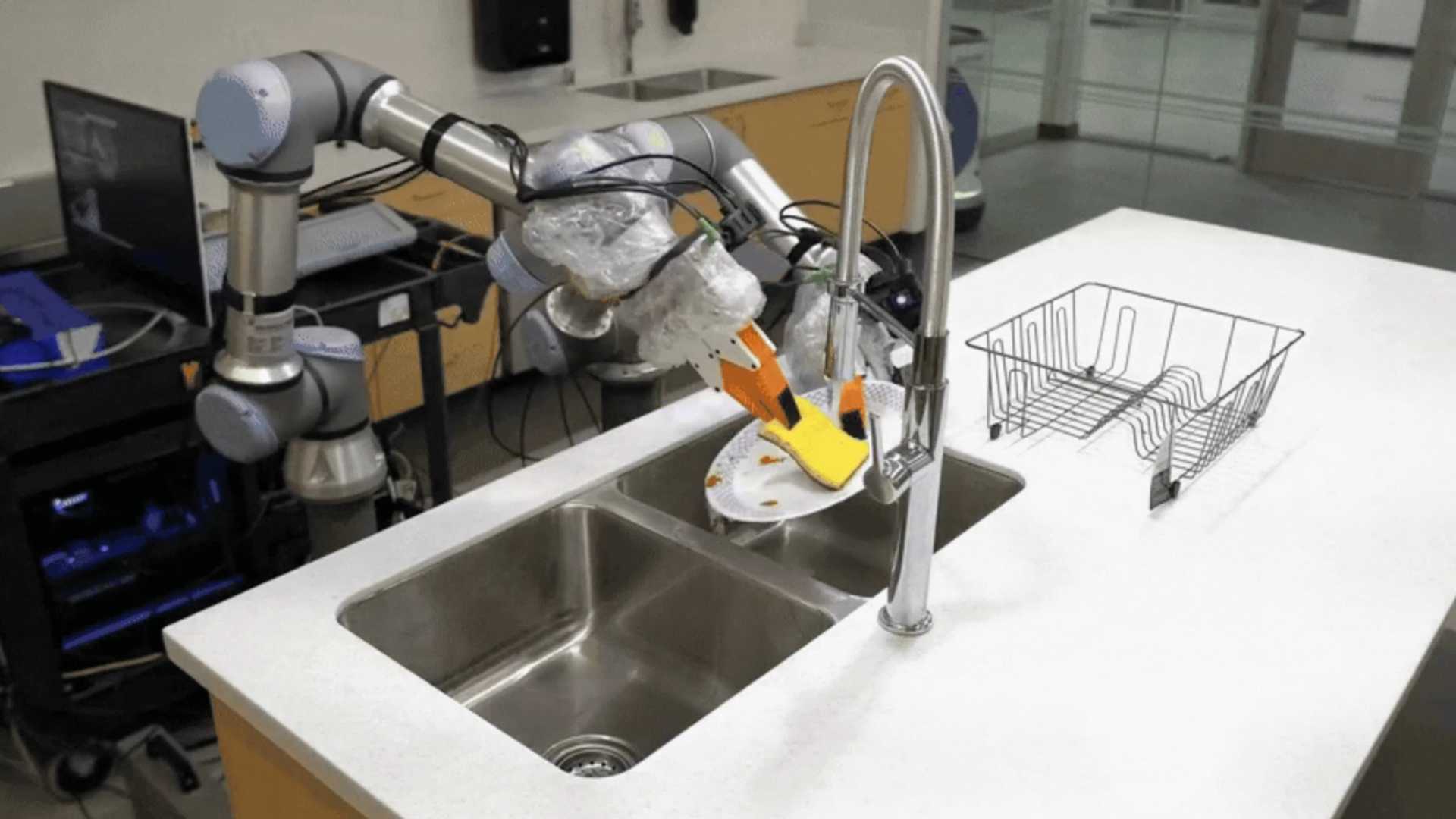
National Robotics Week — Latest Physical AI Research and Developments
Your browser doesn't support HTML5 video. Here is a link to the video instead.
Check back here throughout the week to learn the latest on physical AI, which enables machines to perceive, plan and act with greater autonomy and intelligence in real-world environments. This National Robotics Week, running through April 12, NVIDIA is highlighting the pioneering technologies that are shaping the future of intelligent machines and driving progress across manufacturing, healthcare, logistics, and more.
Advancements in Robotics Simulation and Robot Learning
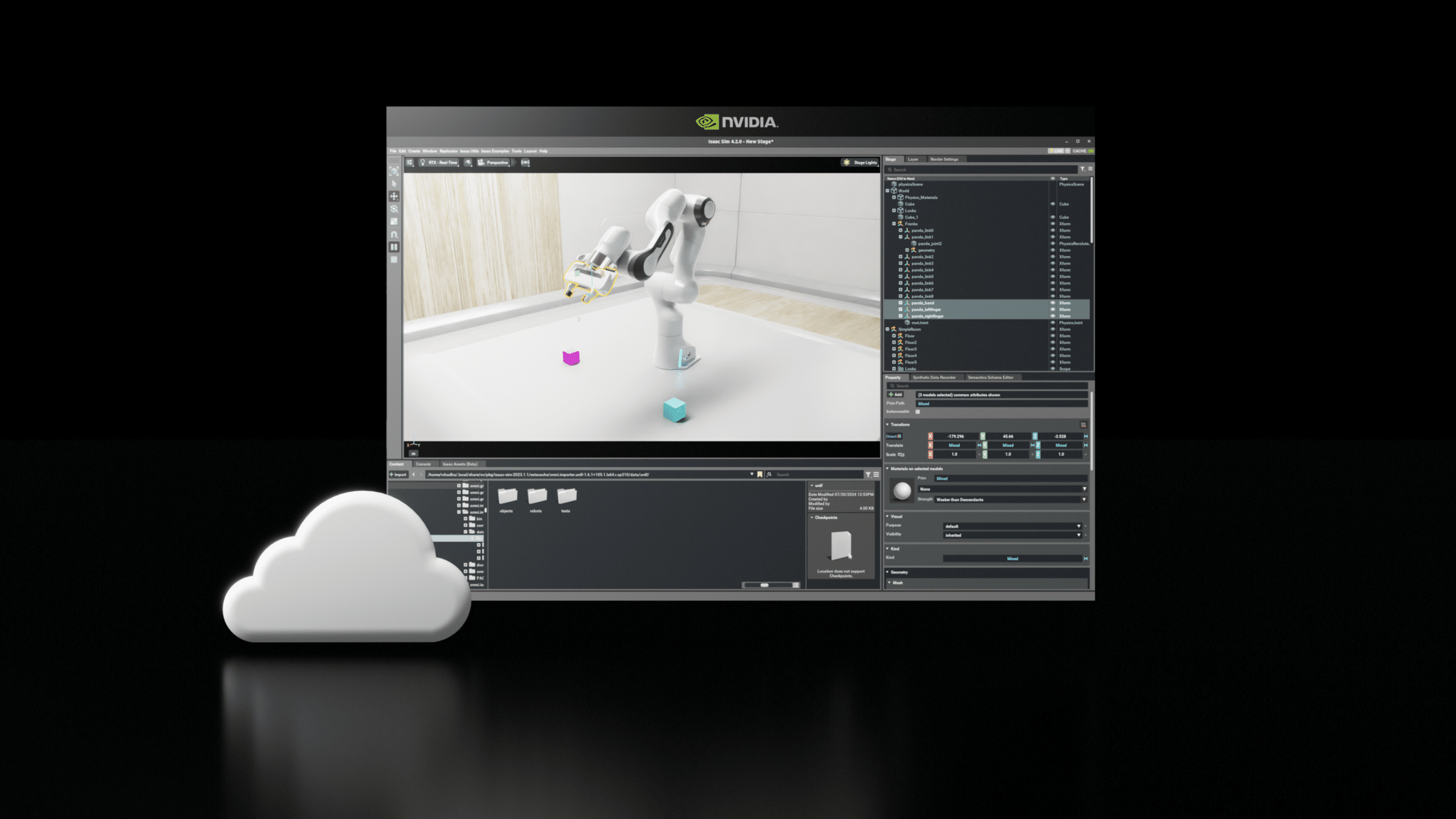
Advancements in robotics simulation and robot learning are driving a fundamental shift in the industry. The emergence of world foundation models is accelerating the evolution of AI-enabled robots capable of adapting to dynamic and complex scenarios. NVIDIA provides robot foundation models like NVIDIA GR00T N1, frameworks such as NVIDIA Isaac Sim, and Isaac Lab for robot simulation and training, as well as synthetic data generation pipelines to help train robots for diverse tasks. The NVIDIA Isaac and GR00T platforms empower researchers and developers to push the boundaries of robotics.
Latest Breakthroughs in Robotics
Watch on-demand sessions from the NVIDIA GTC global AI conference to catch up on recent breakthroughs in robotics, showcased by leading experts in the field.
In his keynote, NVIDIA founder and CEO Jensen Huang announced NVIDIA Isaac GR00T N1, the world’s first open, fully customizable foundation model for generalized humanoid robot reasoning and skills. He also introduced Newton, an open-source, extensible physics engine being developed by NVIDIA, Google DeepMind, and Disney Research to advance robot learning and development.
Developers, researchers, and enthusiasts can explore the following to learn more:
Those looking to dive into robotics development can get started with NVIDIA’s free Robotics Fundamentals Learning Path. This series of self-paced NVIDIA Deep Learning Institute (DLI) courses covers foundational robotics concepts and essential workflows in simulation and robot learning. Each course provides hands-on training across the NVIDIA Isaac platform, including Isaac ROS, Isaac Sim, and Isaac Lab.
Open-source Physical AI Dataset
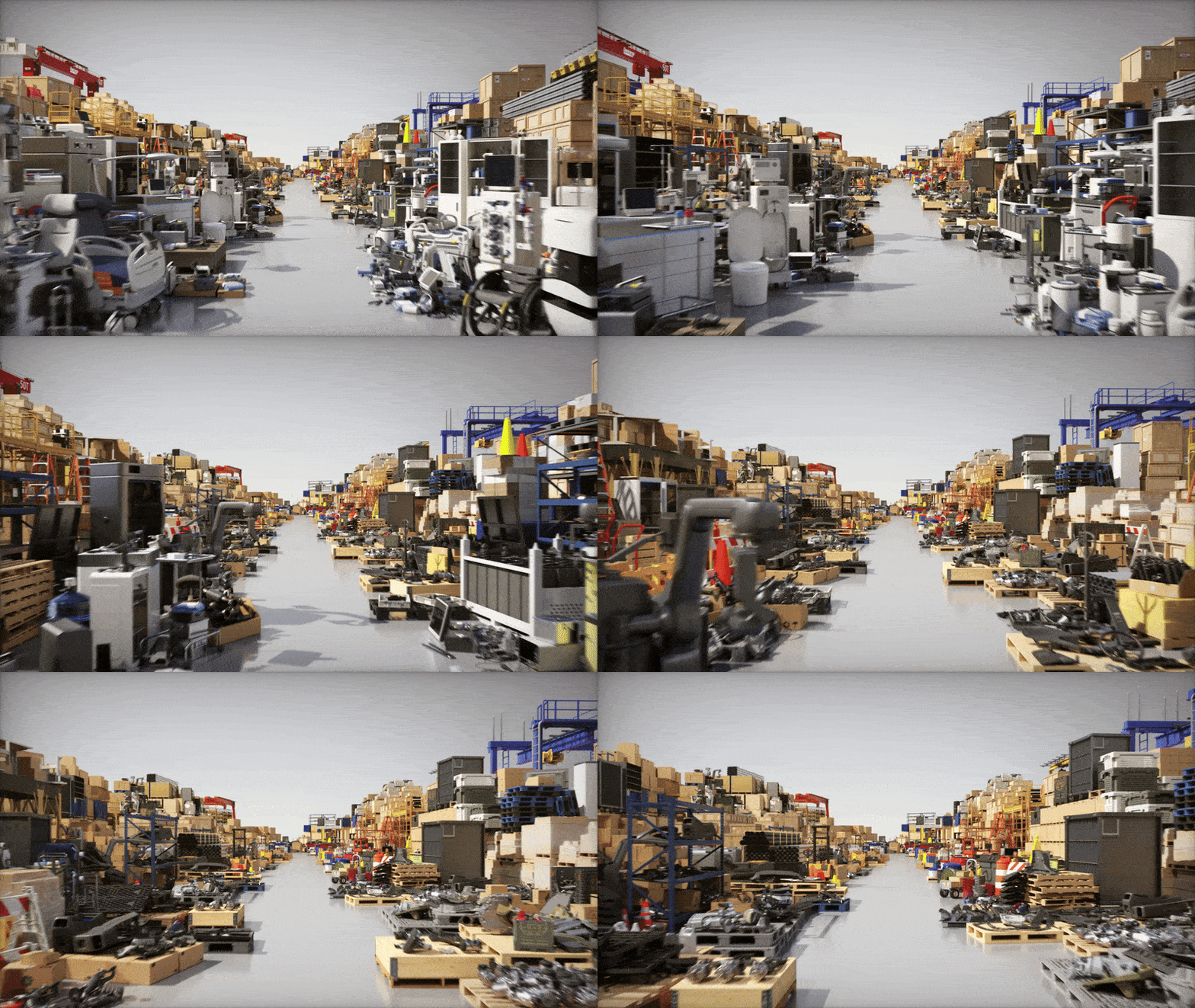
NVIDIA also released a free, open-source physical AI dataset comprising commercial-grade, pre-validated data to help researchers and developers kickstart their projects. The initial dataset offers 15 terabytes of data representing more than 320,000 trajectories for robotics training and 1,000 Universal Scene Description (OpenUSD) assets, including those that are SimReady. Access the NVIDIA Physical AI Dataset on Hugging Face.
Scaled Foundations and NVIDIA Inception
Robots have the potential to automate and scale difficult and repetitive tasks. Scaled Foundations, a member of the NVIDIA Inception program for cutting-edge startups, is lowering the barrier to entry with its GRID platform. By integrating NVIDIA Isaac Sim into GRID, Scaled Foundations provides users with an opportunity to fast-track the development and deployment of advanced robotic AI solutions across new robot types. Developers and students can access state-of-the-art tools to develop, simulate, and deploy robot AI systems — entirely inside a browser.
Access, build, and manage seamless robot intelligence right from your browser. Learn more about how to deploy solutions using Scaled Foundations’ GRID platform by watching the NVIDIA GTC session, Introduction to Robot Simulation: Learn How to Develop, Simulate and Deploy Scalable Robot Intelligence.
Wheeled Lab and NVIDIA Isaac Lab
Wheeled Lab, a research project from the University of Washington, is bringing simulation-to-reality robotics to low-cost, open-source platforms. Integrated with NVIDIA Isaac Lab — a unified framework for robot learning — Wheeled Lab enables reinforcement learning models to train wheeled robots for complex tasks like controlled drifting, obstacle avoidance, elevation traversal, and visual navigation. This pipeline uses domain randomization, sensor simulation, and end-to-end learning to bridge the gap between simulated training and real-world deployment, all while ensuring zero-shot simulation-to-reality transfer.
Get started with the code on GitHub.
Teaching Robots Complex Decision-making
What does it take to teach robots complex decision-making in the real world? Nicklas Hansen, a doctoral candidate at UC San Diego and an NVIDIA Graduate Research Fellow, believes scalable, robust machine learning algorithms are key. With experience from various institutions, Hansen's research addresses long-horizon manipulation and advances humanoid robot control strategies for more adaptive movements.
Hansen's work focuses on making AI-driven robotics more accessible and encourages individuals to explore open-source tools and contribute to projects aligning with their goals and interests.
Hansen is the lead author of TD-MPC2, a model-based reinforcement learning algorithm capable of learning various control tasks without domain knowledge. Learn more about Hansen and other NVIDIA Graduate Fellowship recipients pushing innovation in AI and robotics.
Embodied AI Hackathon and Robotics Community
The Seeed Studio Embodied AI Hackathon brought together the robotics community to showcase innovative projects using the LeRobot SO-100ARM motor kit, highlighting advancements in robot learning.


