Is ChatGPT the key to stopping deepfakes? Study asks LLMs to spot...
When most people think of artificial intelligence, they're probably thinking of—and worrying about—ChatGPT and deepfakes. AI-generated text and images dominate our social media feeds and the other websites we visit, sometimes without us knowing it, and are often used to spread unreliable and misleading information. But what if text-generating models like ChatGPT could actually spot deepfake images?
Research Study
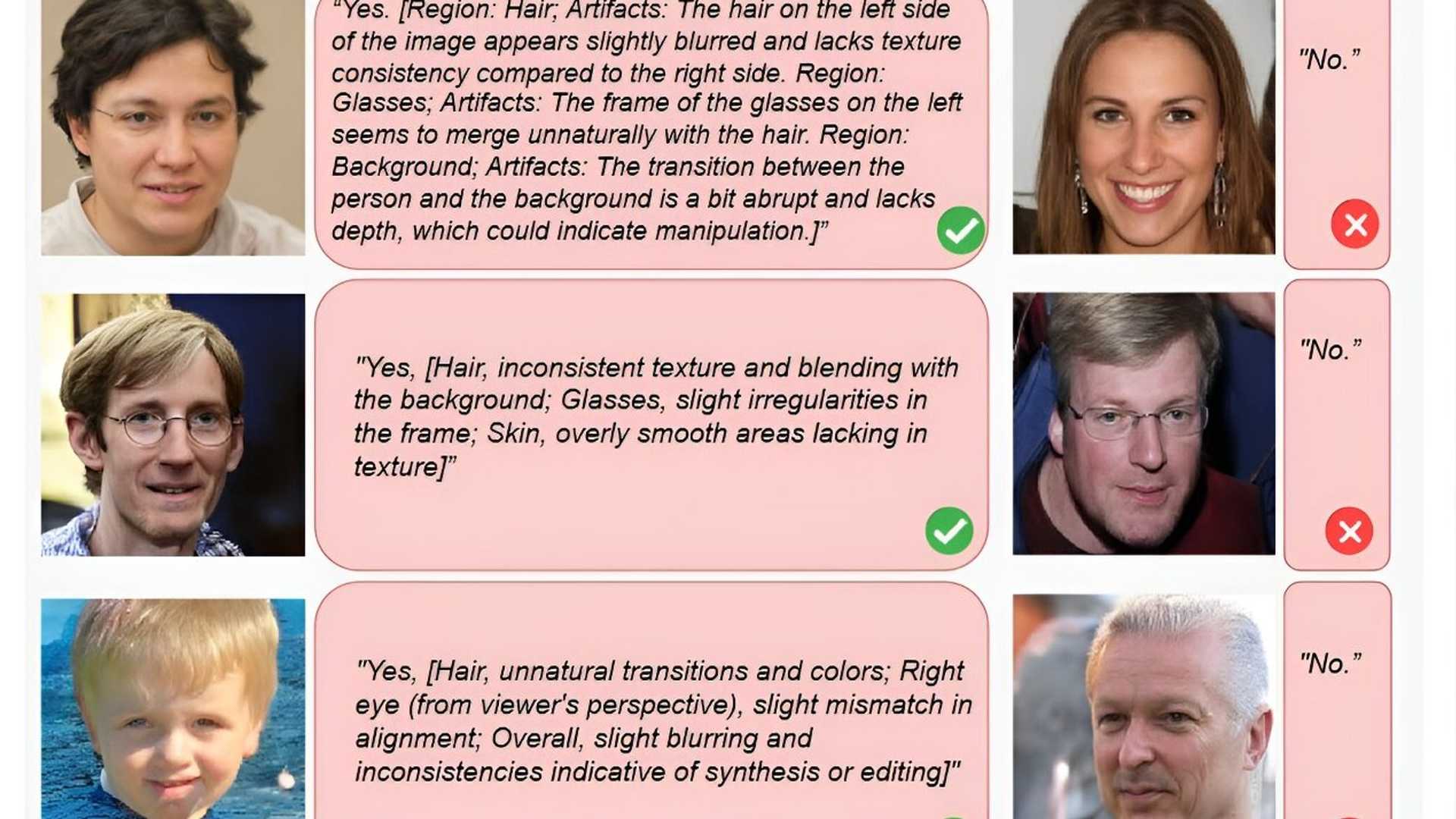
A University at Buffalo-led research team has applied large language models (LLMs), including OpenAI's ChatGPT and Google's Gemini, toward spotting deepfakes of human faces. Their study, presented last week at the IEEE/CVF Conference on Computer Vision & Pattern Recognition, found that LLMs' performance lagged behind that of state-of-the-art deepfake detection algorithms, but their natural language processing may actually make them the more practical detection tool in the future.
![PDF] Can ChatGPT Detect DeepFakes? A Study of Using Multimodal ...](https://d3i71xaburhd42.cloudfront.net/cbb90a94d0cb3334e32c4ae910ac8a3e03dd18da/4-Figure3-1.png "PDF] Can ChatGPT Detect DeepFakes? A Study of Using Multimodal ...")
Published Study
The study is also published on the arXiv preprint server.
Key Findings
"What sets LLMs apart from existing detection methods is the ability to explain their findings in a way that's comprehensible to humans, like identifying an incorrect shadow or a mismatched pair of earrings," says the study's lead author, Siwei Lyu, Ph.D., SUNY Empire Innovation Professor in the Department of Computer Science and Engineering, within the UB School of Engineering and Applied Sciences.
Collaborators on the study include the University at Albany and the Chinese University of Hong Kong, Shenzhen.
ChatGPT's Analysis Abilities
Trained on much of the available text on the internet—amounting to some 300 billion words—ChatGPT finds statistical patterns and relationships between words in order to generate responses. The latest versions of ChatGPT and other LLMs can also analyze images. These multimodal LLMs use large databases of captioned photos to find the relationships between words and images.
"Humans do this as well. Whether it be a stop sign or a viral meme, we constantly assign a semantic description to images," says the study's first author, Shan Jai, assistant lab director in the UB Media Forensic Lab.
Conclusion
ChatGPT's semantic knowledge and natural language processing make it a more user-friendly deepfake tool for both users and developers, the study concluded.
Performance Comparison
ChatGPT's performance was well below the latest deepfake detection algorithms, which have accuracy rates in the mid- to high-90s.
This was partly because LLMs can't catch signal-level statistical differences that are invisible to the human eye but often used by detection algorithms to spot AI-generated images.
And other LLMs may not be as effective at explaining their analysis. Despite performing comparatively to ChatGPT at guessing the presence of synthetic artifacts, Gemini's supporting evidence was often nonsensical.

Another drawback is that LLMs often refused to analyze images. When asked directly whether a photo was generated by AI, ChatGPT typically replied with, "Sorry, I can't assist with that request."
Additional Information
For more information on the study, you can refer to the arXiv publication: Shan Jia et al, Can ChatGPT Detect DeepFakes? A Study of Using Multimodal Large Language Models for Media Forensics, DOI: 10.48550/arxiv.2403.14077


