
IoT to IoE: The Importance of Security - Open Source For You
With humongous amounts of data available on IoT devices in real-time, the connected world has become both exciting and challenging. Systems that prevent access to this data by unauthorized persons have become crucial. A few security principles have been spelt out to ensure a smart home that runs on connected devices is not invaded. Also, some very interesting trends are shaping the future of IoT solutions.
The Internet of Things (IoT) is dominating multi-disciplinary solutions in sectors like retail, manufacturing, and healthcare. IoT services share data in real-time which is analyzed and used for business processing. But for smarter solutions that span different industrial sectors, this may not be enough and unconventional solutions like Internet of Digital (IoD) and Internet of Humans (IoH) are needed.
Internet of Everything (IoE)
Internet of Everything (IoE) is the amalgamation of IoT, IoD, and IoH. It helps to create a connection between people, smart devices, and organizations, and is driven by four principles – people, data, things, and process. New age architecture for interdisciplinary application design needs a ‘boundaryless’ approach. For example, an end-to-end solution for retail stores requires financial services, retail store monitoring services, order processing to manufacturing units, and inventory management.
Internet of Digital is the group of data service applications that handle social networks, media services, data analytics, and cloud platforms, simply termed as SMAC (social, mobile, analytics, and cloud). Internet of Humans deals with the smart devices that interact with humans like smart wristbands and connected medical devices to monitor and collect various datasets. These can be used for remote patient monitoring using cloud-based platforms or remote health advisory solutions through contact center AI services.
Internet of Everything (IoE) is an emerging technology and requires costly infrastructure. However, smart ready-to-use IoE services are the future.
Popular Use Cases of Internet of Everything (IoE)
- Smart cities
- Industrial automation
- Energy management
- Healthcare
- Retail and supply chain management
- Agriculture
- Environmental monitoring
- Connected cars
- Personal safety and security
- Entertainment and gaming
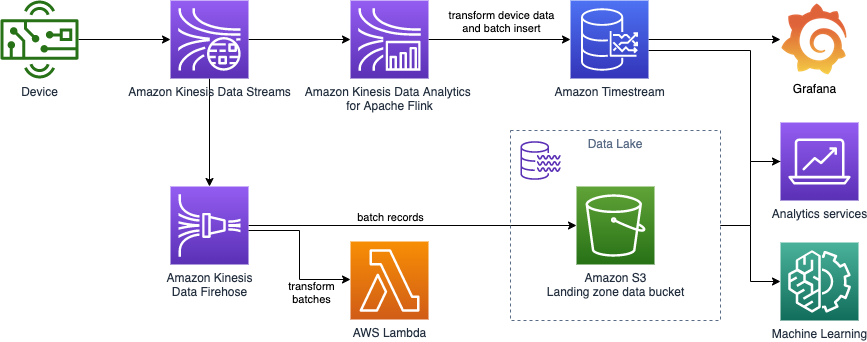
To address this, AWS has developed Timestream, which is a fast, scalable, serverless time series database that performs 1000 times faster than an RDBMS and costs one-tenth of the traditional database platforms. Timestream can store and analyze millions and trillions of events in real-time from IoT sources and can be integrated with SageMaker or QuickSight for analytics, visualization, or processing time series data.
Timestream is serverless and scalable, with an auto-scaling facility to ensure high availability with low cost and optimal resource usage. It can help manage the entire data life cycle. Timestream has a memory store for faster processing of the latest data and magnetic store for low-called historical data. Timestream provides encryption at rest and at motion, and allows key management service (KMS) based customer managed key (CMK) to encrypt historical data (in magnetic stores).

IoT Security Principles
Now let's look at the top 8 IoT security principles that have been laid down keeping modern security threats and vulnerabilities in mind.
No Universal Passwords
Concept: Moving away from a single password for all devices. Each device should have a unique and strong password or use alternative authentication methods like biometrics (fingerprint scan) or multi-factor authentication (MFA).
Real-time example: Imagine a home with multiple smart devices, where each device, like the smart lock, thermostat, and camera, has its own unique password or requires fingerprint verification for access. This prevents a single compromised password from granting access to all devices.
Secured Interfaces
Concept: Securing communication channels between devices, gateways, and the cloud using strong encryption protocols like TLS/SSL. This protects data from eavesdropping and tampering during transmission.
Real-time example: A fitness tracker transmits workout data to a smartphone app. Data encryption ensures only authorized devices can access the data, safeguarding sensitive health information.
Proven Cryptography
Concept: Implementing established and well-tested cryptographic algorithms for encryption and decryption of data. This ensures the confidentiality, integrity, and authenticity of data throughout its life cycle.
Real-time example: A smart home hub uses AES-256 encryption to secure communication between connected devices and the hub. This industry-standard algorithm makes it incredibly difficult for attackers to decipher the data.

Security by Default
Concept: Devices should be shipped with security features enabled by default, requiring no manual configuration by users. This simplifies security for non-technical users and ensures a baseline level of protection.
Real-time example: A new smart speaker comes pre-configured with strong password requirements and automatic software update functionality. This eliminates the risk of users leaving the device vulnerable with weak passwords or outdated software.
Signed Software Updates
Concept: Updates should be digitally signed by the manufacturer to verify their authenticity and prevent installing malicious firmware disguised as updates.
Real-time example: A notification appears on a smart TV prompting for a software update. The update is digitally signed by the manufacturer, assuring users it’s legitimate and not a tampered version.
Software Updates Applied Automatically
Concept: Devices should automatically download and install security patches whenever they become available. This ensures devices are always protected against the latest vulnerabilities.
Real-time example: A smart thermostat automatically downloads and installs a security patch that addresses a recently discovered vulnerability in its software. This eliminates the need for manual intervention and ensures timely protection.
Vulnerability Reporting Scheme
Concept: Establishing a clear and accessible channel for users and researchers to report discovered vulnerabilities to manufacturers. This allows for prompt identification, investigation, and patching of vulnerabilities.
Real-time example: Security researchers discover a vulnerability in a popular smart home camera brand. They report the vulnerability through the manufacturer’s dedicated vulnerability reporting portal. The manufacturer promptly investigates, develops a patch, and releases it to all users.
Security Expiration Date
Concept: Assigning a lifespan to the security capabilities of a device. Manufacturers should clearly communicate when a device will no longer receive security updates or support, allowing users to make informed decisions about continued use or replacement.
Real-time example: A manufacturer announces that a specific model of smart sensors will no longer receive security updates after a certain date. Users are advised to upgrade to newer models with ongoing security support to maintain protection against evolving threats.
By adhering to these principles, manufacturers and users can work together to create a more secure IoT ecosystem, mitigating the risks associated with connected devices and protecting sensitive data in today’s ever-evolving threat landscape.
A secure smart home is a living space that leverages the convenience and security benefits of interconnected devices while prioritizing data protection and minimizing vulnerabilities. In a smart home, security is a top priority. Here’s what it entails:
Key Components for Smart Home Security
- Network router and firewall: This acts as the central control point for your network traffic. A good firewall filters incoming and outgoing data, blocking unauthorized access attempts.
- Smart hub (optional): This centralizes communication between various IoT devices and serves as a control center for your smart home ecosystem. Choose one with robust security features.
- IoT devices: Smart lights, thermostats, locks, cameras, and more – these are the gadgets that bring intelligence to your home. Ensure each one has strong security capabilities.
- Intrusion detection/prevention system (optional): These systems actively monitor your network for suspicious activity and can take steps to prevent cyberattacks.


