Transforming the Future: The Impact of AI on Our Everyday Lives
Artificial Intelligence (AI) has indeed become a transformative force across various industries and aspects of daily life. To stay relevant and thrive in this AI-driven world, it's crucial to understand and adapt to these changes. Overcoming the fear of something new begins with learning. Let’s make AI approachable by breaking it down into manageable steps.
Understanding AI: A Brief Overview
AI refers to the simulation of human intelligence in machines programmed to think and learn like humans. The core components of AI include machine learning, neural networks, and natural language processing. These technologies enable machines to perform tasks that typically require human intelligence, such as visual perception, speech recognition, and decision-making.
Starting Your AI Journey
⦁ Understand the Basics: Start with the fundamentals of AI, including concepts like machine learning, deep learning, neural networks, and natural language processing. There are many online resources and courses available for beginners, such as Coursera, edX, and Khan Academy.
⦁ Stay Updated with Trends: AI is a rapidly evolving field. Keep up with the latest trends, breakthroughs, and applications by following AI news sites, research journals, and influential AI researchers on social media platforms.
⦁ Hands-on Practice: Practical experience is essential. Engage with platforms like Kaggle for data science competitions, or use TensorFlow and PyTorch to build and experiment with your own AI models.
⦁ Learn to Code: Proficiency in programming languages commonly used in AI, such as Python, is vital. Python libraries like NumPy, pandas, scikit-learn, and Keras are frequently used in AI projects.
⦁ Study Applied AI: Explore how AI is being applied in various fields such as healthcare, finance, automotive, and entertainment. This can provide insights into potential career paths and applications of AI in your area of interest.
⦁ Join AI Communities: Engage with communities such as AI forums, LinkedIn groups, and local meetups. These can provide networking opportunities, mentorship, and collaborative learning environments.

⦁ Ethics and Implications: Understanding the ethical implications of AI is crucial. Study topics like bias in AI, privacy concerns, and the societal impact of AI technologies. Courses and literature on AI ethics can provide valuable perspectives.
⦁ Advanced Studies: For a deeper dive, consider advanced studies in AI, such as a specialized master’s program or online certifications from reputable institutions.
Applications of AI Across Industries
Healthcare
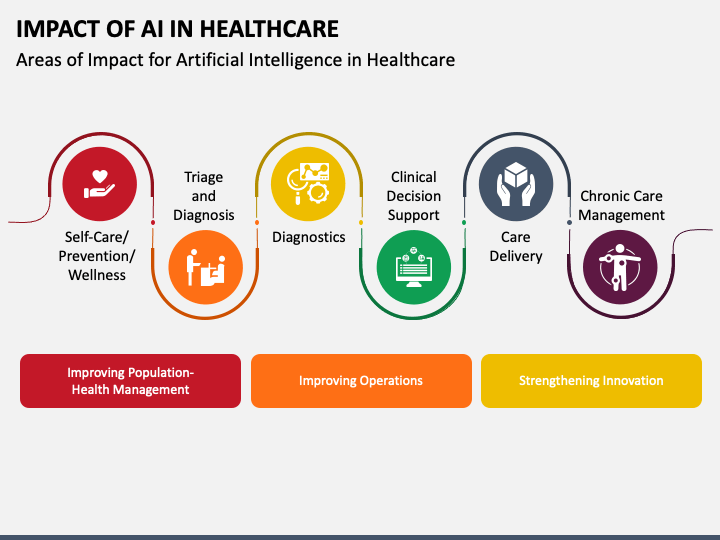
AI is revolutionizing healthcare with applications in diagnostics, treatment planning, and patient care. AI-powered tools can analyze medical images, predict disease outbreaks, and even assist in surgeries. The potential to save lives and improve healthcare efficiency is immense.
Finance
In the finance sector, AI is used for fraud detection, algorithmic trading, and personalized banking. AI algorithms can analyze vast amounts of data to identify fraudulent activities and make investment decisions in real time. Additionally, AI-driven chatbots provide customer support, making banking more accessible and convenient.
Key AI Concepts
Machine learning can be of two types:
Supervised Learning: The dataset used to train the model is labeled. For example, given a set of images labeled ‘cat’ and ‘not a cat’, the model learns to identify cat images.
Unsupervised Learning: The dataset is not labeled. For example, given a set of images, the model groups them together based on similarities.
Neural Networks
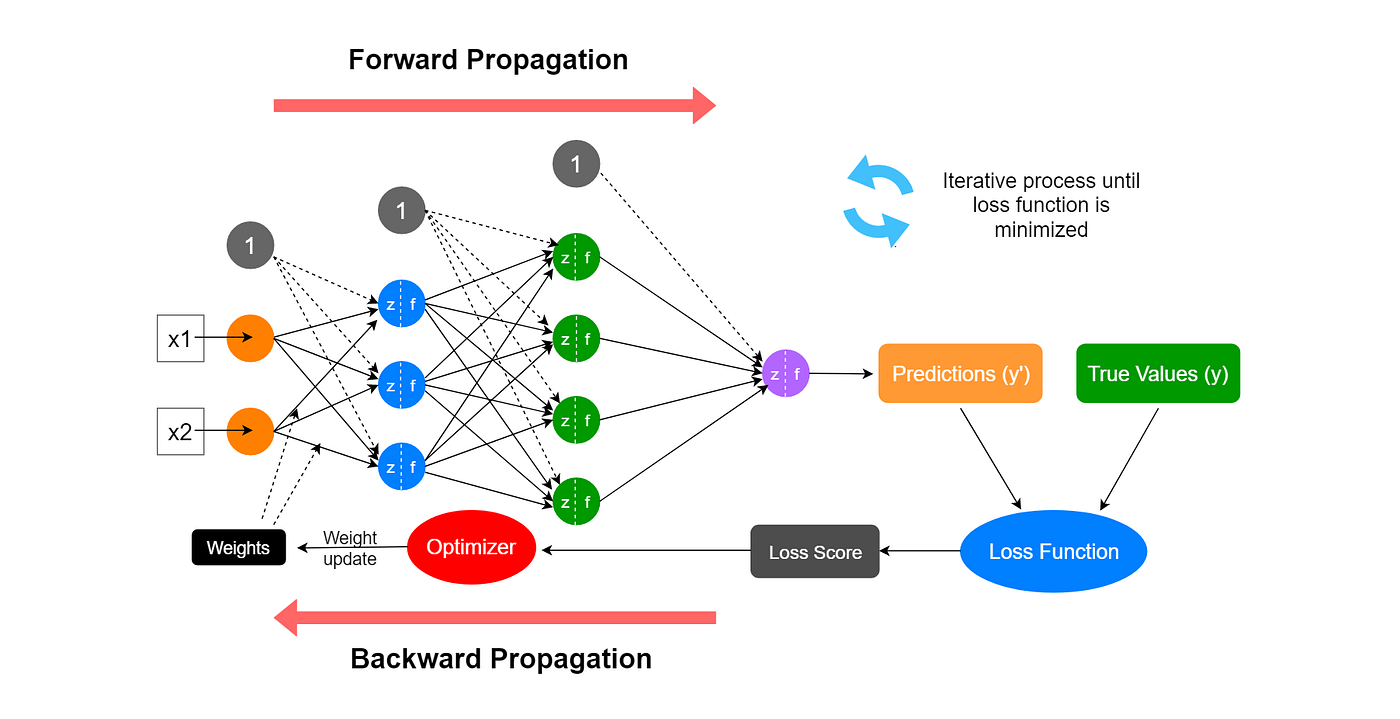
Neural networks are the backbone of machine learning as well as generative AI. They are inspired by the human brain and use interconnected nodes or neurons to identify patterns and learn from large datasets.
Forward Propagation: The process of passing input data through the network’s layers to compute and produce an output.








