Join our daily and weekly newsletters for the latest updates and exclusive content on industry-leading AI coverage. Learn More
Mistral AI's new coding assistant takes direct aim at GitHub Copilot...
Mistral AI unveiled a comprehensive enterprise coding assistant Wednesday, marking the French artificial intelligence company’s most aggressive push yet into the corporate software development market dominated by Microsoft’s GitHub Copilot and other Silicon Valley rivals.
The new product, called Mistral Code, bundles the company’s latest AI models with integrated development environment plugins and on-premise deployment options specifically designed for large enterprises with strict security requirements. The launch directly challenges existing coding assistants by offering what the company says is unprecedented customization and data sovereignty.
Customized AI Models for Enterprise Needs
“Our most significant features are that we propose more customization and to serve our models on premise,” said Baptiste Rozière, a research scientist at Mistral AI and former Meta researcher who helped develop the original Llama language model, in an exclusive interview with VentureBeat. “For customization, we can specialize our models for the customer’s codebase, which can make a huge difference in practice to get the right completions for workflows that are specific to the customer.”
Focus on Data Privacy and Compliance
The enterprise focus reflects Mistral’s broader strategy to differentiate itself from OpenAI and other American competitors by emphasizing data privacy and European regulatory compliance. Unlike typical software-as-a-service coding tools, Mistral Code allows companies to deploy the entire AI stack within their own infrastructure, ensuring that proprietary code never leaves corporate servers.
Addressing Enterprise Challenges
The product launch comes as enterprise adoption of AI coding assistants has stalled at the proof-of-concept stage for many organizations. Mistral surveyed vice presidents of engineering, platform leads, and chief information security officers to identify four recurring barriers: limited connectivity to proprietary repositories, minimal model customization, shallow task coverage for complex workflows, and fragmented service-level agreements across multiple vendors.
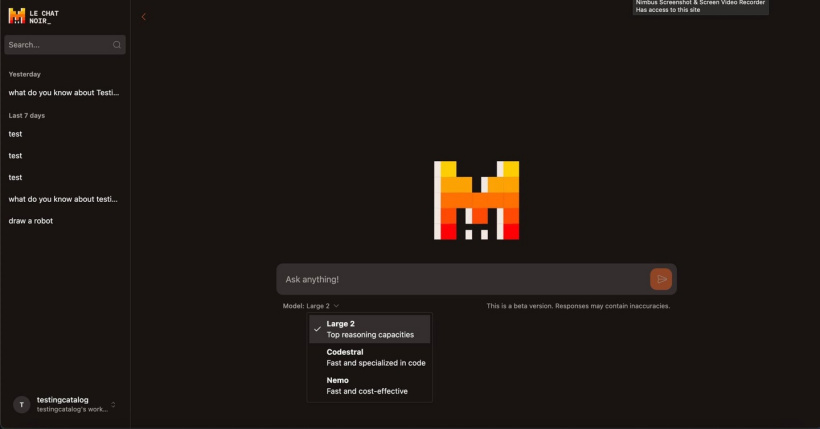
Mistral Code addresses these concerns through what the company calls a “vertically-integrated offering” that includes models, plugins, administrative controls, and 24/7 support under a single contract. The platform is built on the proven open-source Continue project but adds enterprise-grade features like fine-grained role-based access control, audit logging, and usage analytics.
Specialized AI Models for Coding
At the technical core, Mistral Code leverages four specialized AI models: Codestral for code completion, Codestral Embed for code search and retrieval, Devstral for multi-task coding workflows, and Mistral Medium for conversational assistance. The system supports more than 80 programming languages and can analyze files, Git differences, terminal output, and issue tracking systems.
Focus on Data Security
Crucially for enterprise customers, the platform allows fine-tuning of underlying models on private code repositories — a capability that distinguishes it from proprietary alternatives tied to external APIs. This customization can dramatically improve code completion accuracy for company-specific frameworks and coding patterns.
Deployment and Adoption
Early enterprise customers validate Mistral’s approach across regulated industries where data sovereignty concerns prevent adoption of cloud-based coding assistants. Abanca, a leading Spanish and Portuguese bank, has deployed Mistral Code at scale using a hybrid configuration that allows cloud-based prototyping while keeping core banking code on-premises. SNCF, France’s national railway company, uses Mistral Code Serverless to empower its 4,000 developers with AI assistance. Capgemini, the global systems integrator, has deployed the platform on-premises for more than 1,500 developers working on client projects in regulated industries.
The platform is built on the proven open-source Continue project but adds enterprise-grade features like fine-grained role-based access control, audit logging, and usage analytics.
Market Positioning and Competitive Landscape
The enterprise coding assistant market has attracted major investment and competition from technology giants. Microsoft’s GitHub Copilot dominates with millions of individual users, while newer entrants like Anthropic’s Claude and Google’s Gemini-powered tools compete for enterprise market share.
Regulatory Advantages and Funding
Mistral’s European heritage provides regulatory advantages under the General Data Protection Regulation and the EU AI Act, which impose strict requirements on AI systems processing personal data. The company’s €1 billion in funding, including a recent €600 million round led by General Catalyst at a $6 billion valuation, provides resources to compete with well-funded American rivals.

Future Developments and Innovations
Mistral Code goes far beyond basic code completion to encompass entire project workflows. The platform can open files, write new modules, update tests, and execute shell commands—all under configurable approval processes that maintain senior engineer oversight.
The system’s retrieval-augmented generation capabilities allow it to understand project context by analyzing codebases, documentation, and issue tracking systems. This contextual awareness enables more accurate code suggestions and reduces the hallucination problems that plague simpler AI coding tools.
Conclusion
Mistral's success in attracting top talent from Meta and other leading AI labs demonstrates the ongoing consolidation of expertise within a small number of well-funded companies. This concentration of talent accelerates innovation while potentially limiting the diversity of approaches to AI development.
For enterprises evaluating AI coding tools, Mistral Code offers a European alternative to American solutions.