
The Rise of Meta Platforms in the Technology Sector
In recent years, the technology sector has experienced a remarkable renaissance, repositioning itself atop the list of the world's most valuable companies. Not long ago, industrial giants like General Electric and ExxonMobil led the market caps, symbolizing strength and stability with valuations of roughly $319 billion and $283 billion, respectively. Fast forward two decades, and familiar names in technology have not only emerged but now dominate this space.
The leaders of this transformation include some of the most recognized brands across the globe. Prominently, Apple has reached an astounding market cap of $3.5 trillion with its stock soaring to unprecedented highs. Close on its heels are Nvidia and Microsoft, boasting market values of $3.4 trillion and $3 trillion. This shift underscores the evolving landscape where technology firms are driving economic growth and innovation.
The Success Story of Meta Platforms
Amid this backdrop, Meta Platforms (NASDAQ: META) stands out with a market capitalization currently assessed at approximately $1.4 trillion. Despite recent economic hardships, Meta's stock has surged impressively by 80% over the past year and astoundingly by over 694% in the last decade. The company’s progress suggests that it is set to follow in the footsteps of its larger counterparts and possibly join the coveted $3 trillion club.
Meta’s success story is tightly interwoven with its robust social media platforms, including Facebook, Instagram, Threads, Messenger, and WhatsApp, which collectively hosted 3.27 billion users, marking a 7% increase from the previous year. Additionally, Meta's thriving digital advertising sector has emerged as a crucial revenue driver, reinforcing its core business strategies.
Future Strategies and Innovations
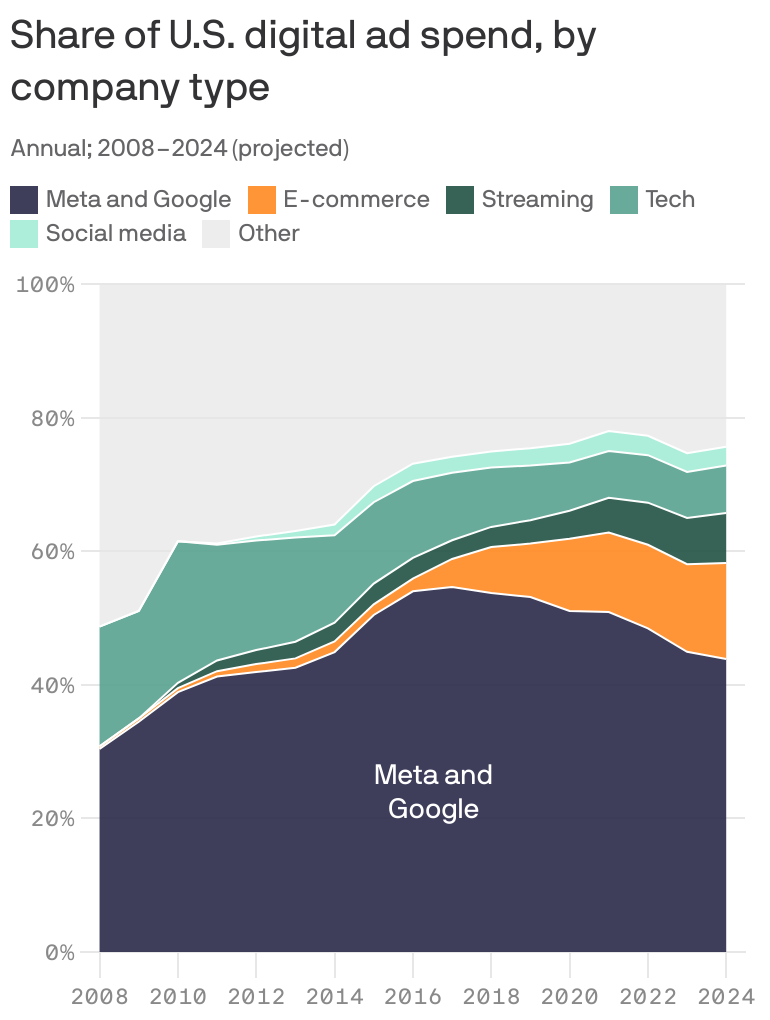
The digital advertising market is witnessing a substantial recovery, projected to expand by approximately 8% and exceed $1 trillion this year. This rebound is especially beneficial for Meta, as its advertising services capture vital market share against competitors like Alphabet's Google, which commands 39% of the global market.
As Meta continues to leverage its significant user base for advertising, it anticipates oversized gains moving forward. The company's advertisement models are intricately linked to its social media ecosystem, further enhancing its revenue potential.

A noteworthy aspect of Meta's future strategy involves convening resources towards artificial intelligence (AI). The company's data-driven initiatives have led to the development of advanced language models encapsulated in their LLaMA (Large Language Model Meta AI) system, setting a benchmark in generative AI technology.
LLaMA 3, the recent iteration of this AI, has positioned Meta at the forefront of AI assistance innovation. While available for free to individual users, the company has introduced pricing models for enterprises, which will add another layer of potential revenue generation.
Path to a $3 Trillion Market Valuation
As Meta Platforms seeks to reach a market valuation of $3 trillion, numerous factors are at play. The firm requires roughly a 105% increase in its stock price to attain this ambitious target. Projections indicate that with ample revenue growth, particularly estimated at $161.9 billion in 2024, Meta could feasibly generate the required momentum.
For potential investors considering whether to invest in Meta Platforms, the information paints a promising picture. With its diverse growth opportunities spanning advertising, AI, and virtual reality, Meta is a formidable player in the technology sector. The company's remarkable ability to adapt and innovate positions it as a compelling option for investors looking to capitalize on future growth trajectories.

Analysts suggest that with continued growth, Meta could aim for a market cap of $3 trillion by achieving substantial revenue increases over the coming years.
Investors Hangout