Guide to AI Chatbots for Marketers: Overview, Top Platforms, Use ...
Boost your brand and generate demand with media programs. Read through guides, explore resource hubs, and sample our coverage. Register for an upcoming webinar and track which industry events our analysts attend. Listen to our podcast, Behind the Numbers for the latest news and insights. Learn more about our mission and how EMARKETER came to be. Key decision-makers share why they find EMARKETER so critical. Take a look into our corporate culture and view our open roles. Rigorous proprietary data vetting strips biases and produces superior insights. See our latest press releases, news articles, or download our press kit. Speak to a member of our team to learn more about EMARKETER.
The Rise of AI Chatbots
The conversational interface has gotten a big boost with the rise of ChatGPT and generative AI. Sign up for the EMARKETER Daily Newsletter. The advent of natural language processing (NLP), machine learning (ML), and AI has transformed chatbots, remaking how we interact with software, work, search, and information processing.
AI chatbots are software that simulate human-like conversations, engaging users through text and speech. Using advanced natural language processing and machine learning algorithms, they can understand and process complex user queries with increasing accuracy. Chatbots can handle tasks like customer service, booking reservations, providing recommendations, and assisting with sales. They’re used across websites, messaging apps, and social media, and include standalone chatbots like OpenAI’s ChatGPT, Google’s Gemini, Microsoft’s Copilot, and more.
Evolution of AI Chatbots

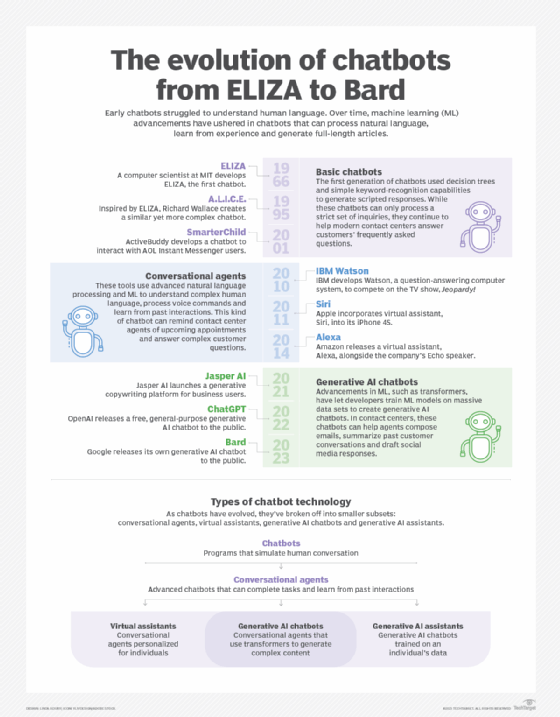
While basic chatbots rely on scripts and decision trees, modern AI-powered chatbots use sophisticated NLP and ML to understand context and nuances of human language. This evolution has improved their performance, addressing previous limitations that led to poor customer experiences. AI chatbots analyze user inputs to determine intent, generate relevant and personalized responses, and learn from interactions. This involves linguistic rules, pattern recognition, and sentiment analysis, enabling natural and complex conversations.
As chatbots’ applications in marketing and commerce evolve, their impact on industry is wide and varied. Here are a few stats to consider:
- ChatGPT is the chatbot that started the AI race with its public release on November 30, 2022. Created by OpenAI, GPT stands for “generative pre-trained transformer.” It’s designed to answer user questions, including simple queries for facts or complex instructions for generating content and communications.
- Google has rapidly evolved its AI offerings to compete with ChatGPT. In December 2024, Google introduced Gemini 2.0, designed for the “agentic era” with improved multimodal capabilities and native tool use.
- Anthropic released Claude 3.7 Sonnet in January 2025, with significant upgrades in October 2024.
AI Chatbots in Search
The rise of AI chatbots is set to change how consumers search for information online. In addition to offering a more natural interface, AI chatbots can summarize information and create original responses based on internet sources without the usual list of links from today’s search engine results. Google, Microsoft, and other companies are integrating chatbots into their search experiences to enhance user interactions.
Chatbot Marketing
Chatbot marketing uses AI-powered conversational interfaces across digital platforms to engage customers, sell products, and provide information. EMARKETER analyst Jacob Bourne mentioned on the “Behind the Numbers” podcast how AI chatbots powered by generative AI have revolutionized customer interactions. Engaging customers through chatbots generates important data since every interaction improves marketer understanding of user intent.
Future of AI Chatbots
The next 12 months promise a wave of innovative chatbot applications. Despite their potential, chatbots face several obstacles. To mitigate these risks, retailers should implement strict guardrails. Over 80% of US consumers believe businesses should prioritize data privacy using robust data anonymization techniques, while 86% want regular internal audits to assess generative AI systems for biases, fairness, and security vulnerabilities, according to a January 2024 KPMG study.