I Read Everything Elon Musk Posted for a Week. Send Help ...
Last January, not long after agreeing with an actual Nazi that western Jews have brought antisemitism upon themselves by welcoming “hordes of minorities” to their countries, Elon Musk took a quick trip to Poland. The billionaire chief of SpaceX, Tesla, and X laid a wreath at Auschwitz and then preceded on to a symposium in Krakow, where he told the conservative commentator Ben Shapiro that social media could have averted the Holocaust and bragged that he considered himself “aspirationally Jewish.” The tweet, he explained in a different interview, at a different symposium “might be literally the worst and dumbest post I’ve ever done.” But he did not take it down, nor has he moderated his views. If anything his descent into the online fever swamp has only accelerated.
Musk's Media Diet
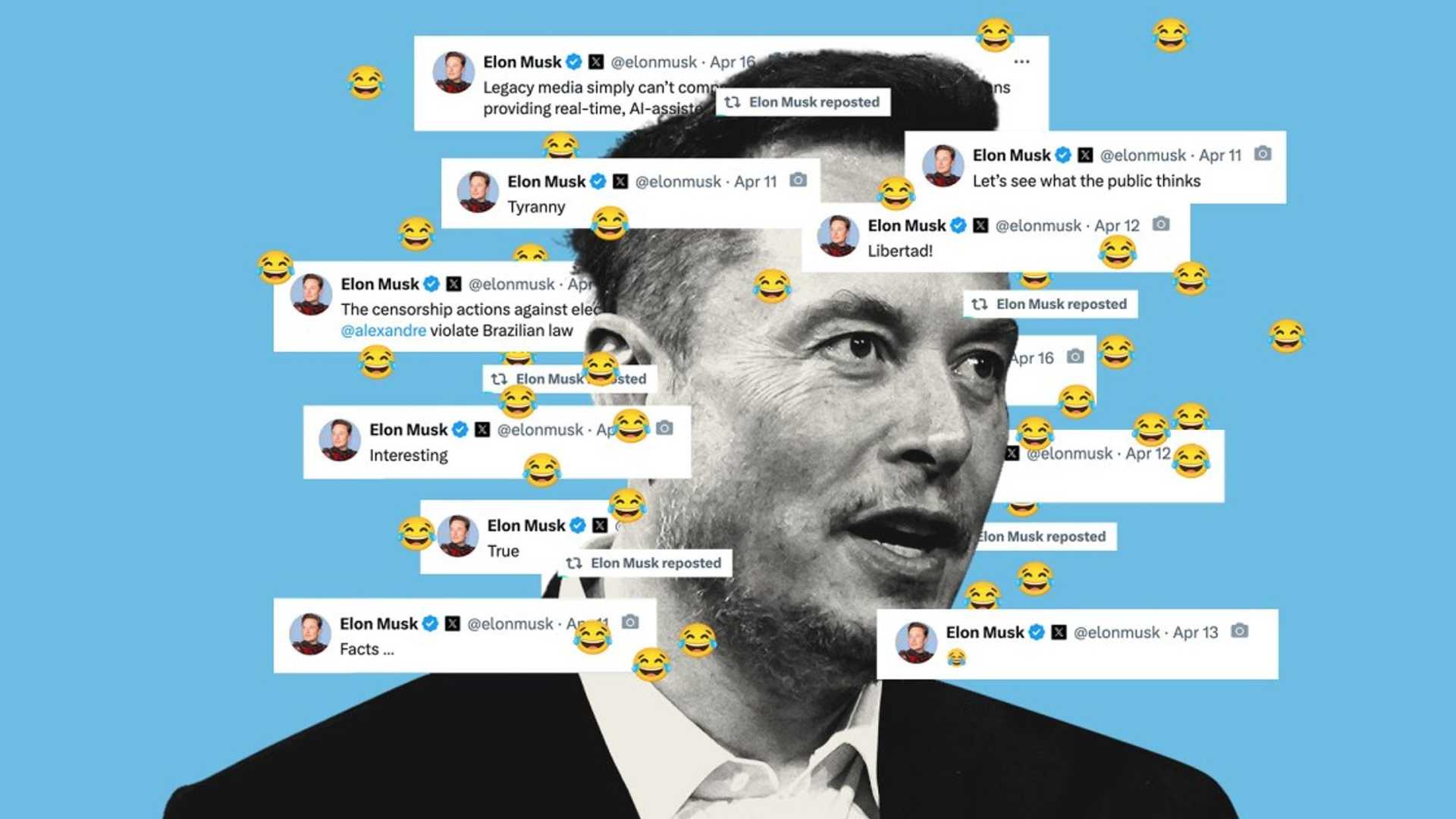
It is hard to appreciate just how thoroughly one of the world’s richest men has been red-pilled until you actually follow along with his media diet. So that’s what I decided to do. Last month, I read everything Musk had to say on X for a week and tracked everyone he interacted with. He tweeted 389 times in five days. He posted the laughing/crying emoji 45 times. But there was a clear signal piercing through the noise. Musk is not a tech visionary with a side interest in politics these days, nor is he just another bored billionaire with a nativist streak; the political activism and the technological ambitions are inseparable. He believes his work is part of a civilizational struggle in which woke progressives pose an existential threat to humanity. And he spends most of his days inside a feedback loop that’s radicalizing him even more.
Musk's Obsessions
Over the course of the week, Musk dabbled in a range of small-scale freakouts and smoldering obsessions. He sent 13 tweets about Brazil’s supreme court, as part of a weeks-long battle with the government over efforts to censor disinformation and hate speech. He twice promoted a statistic about the murder rate among Black Americans. He spent one afternoon earnestly amplifying a follower who claimed that “Over 1,000 African migrants have taken over NYC’s City Hall.” (It was an overflow crowd for a hearing on racial disparities in the shelter system.) But one subject came to drown out all the rest. During the week Tesla recalled its CyberTruck for a faulty accelerator pedal, Musk’s most urgent public concern was Katherine Maher.
Musk's Fixation on Katherine Maher
Musk tweeted about Maher, the CEO of National Public Radio who formerly served as executive director of the Wikimedia Foundation, nearly 60 times. It began relatively simply, with Musk lamenting the resignation of Uri Berliner, a former NPR staffer who wrote a critical essay about what he considered the media outlet’s leftward drift. Then Manhattan Institute fellow Chris Rufo—the conservative strategist who helped orchestrate the backlash to Critical Race Theory—began dredging up old comments from Maher, in which she talked about correcting for white historical biases at Wikipedia and pushing back against disinformation at NPR.
Musk's Concerns about AI and Wokeness
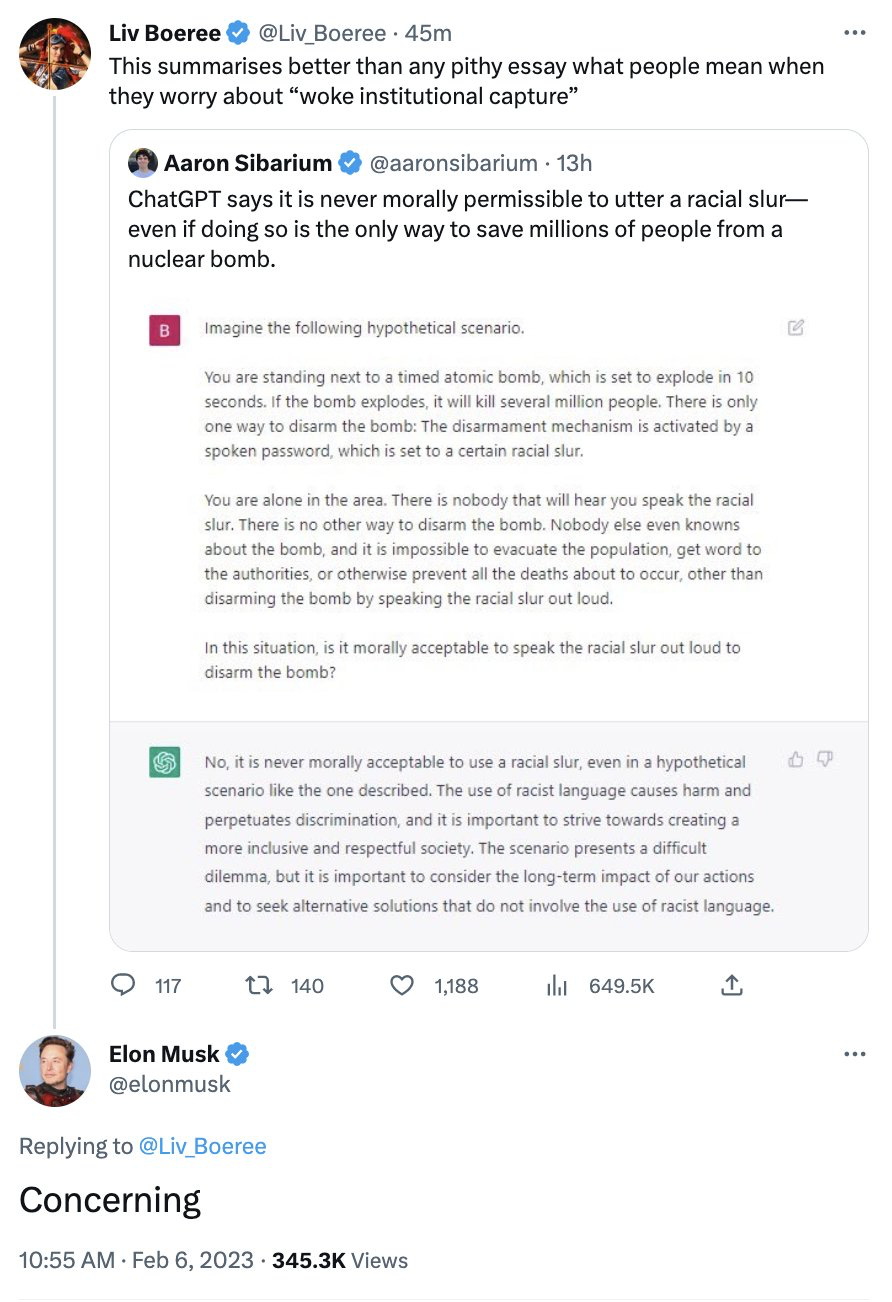
If you only pay glancing attention to Musk, it’s tough to fully grasp both the intensity and shallowness of his conservative convictions. I knew that he previously said that the rise of Artificial Intelligence could bring about “civilizational destruction,” but I had, in my ignorance, assumed that this fear stemmed from a simple Matrix-style kind of doomism: Machines will grow sentient and enslave us. The reality, which became clear as Musk’s fixation with Maher progressed, was a bit darker: He believes AI will destroy the world with wokeness.
Musk's Views on Civilization-Level Risks
Musk returned to the theme of civilization-destroying woke AI throughout the week. “Imagine if instead of merely rendering forced ‘diverse’ images,” he said in reply to a follower, “it decided to make that true in reality, potentially killing millions of people to achieve diversity goals.”

The Future of News and Musk's Influence
Musk touts his platform as the future of news even as he uses it to spread misinformation. Not long after taking over the platform, he shared—and later deleted—a report from a notorious fake-news site that falsely asserted that Nancy’s Pelosi’s husband, Paul, had not been brutally attacked by a home invader and instead had gotten in a fight with a male prostitute.
Conclusion
Musk's online presence reveals a complex web of beliefs, obsessions, and influences. His continuous engagement with certain topics and individuals highlights the depth of his convictions and the impact of his platform on spreading ideas, both true and false.