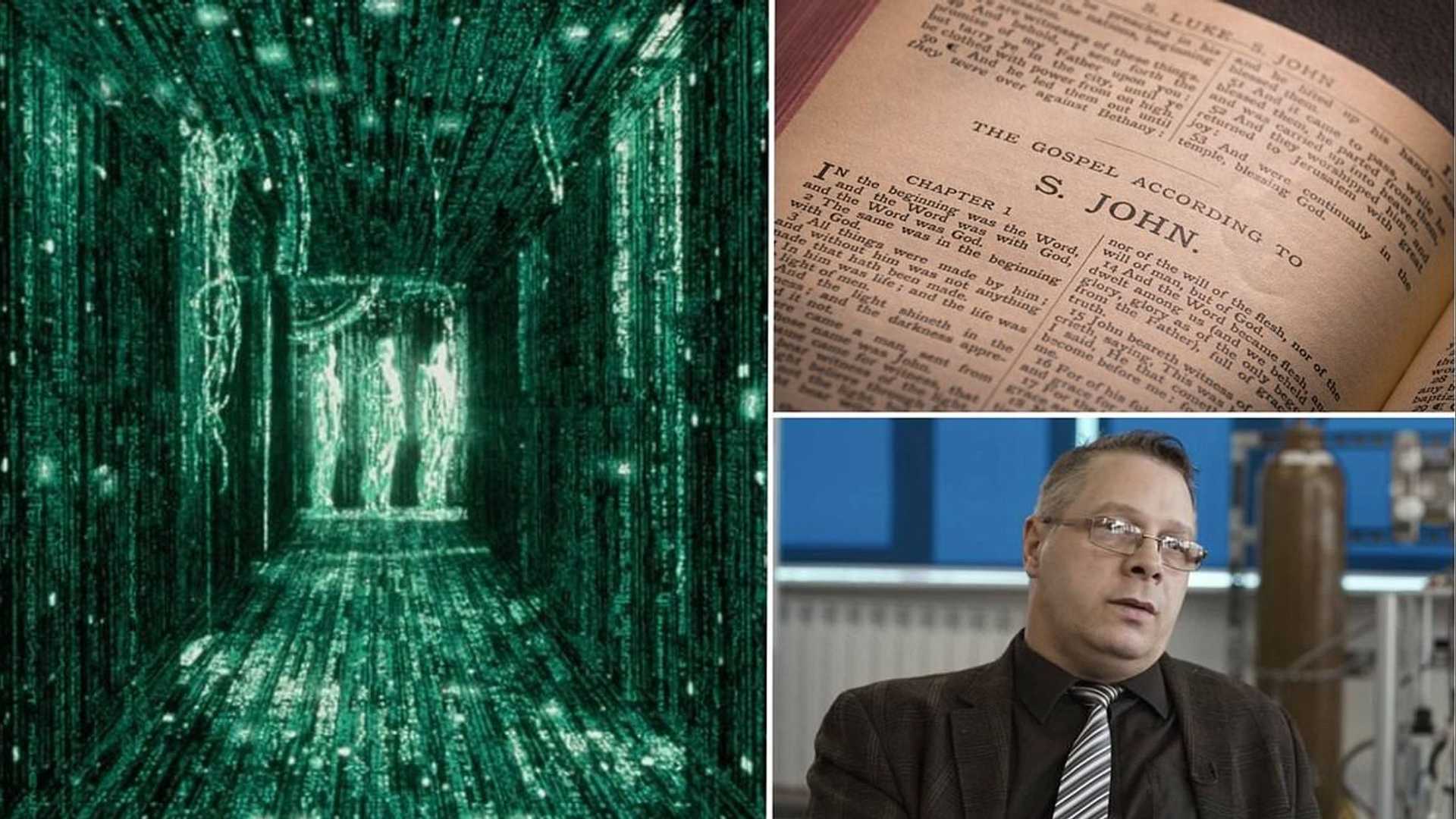
Are we living in a simulation? Scientist claims we're simply...
If you feel like you're living in a convincing virtual reality akin to The Matrix, a scientist thinks you may well be right. Melvin Vopson, an associate professor in physics at the University of Portsmouth, claims our entire universe may be an advanced computer simulation. And the proof that this so-called simulation hypothesis is correct may be hiding in plain sight in the Bible.
The Simulation Hypothesis
Professor Vopson points to the Gospel of John, one of the first four books of the New Testament, the second part of the Christian Bible. Gospel of John opens with the powerful statement: 'In the beginning was the Word, and the Word was with God, and the Word was God.'

The professor says this verse has 'deep theological significance in Christian doctrine', but it also carries 'intriguing implications' when considered in the context of the universe as a simulation. He argues that 'the Word' in this famous sentence refers to the underlying computer code that governs and controls the simulation. As anyone who has seen The Matrix will know, any computer simulation, big or small, consists of letters and numbers that write the rules for the entire creation.
The Universe as a Computer Simulation
The simulated universe hypothesis proposes that what humans experience is actually an artificial reality, much like a computer simulation, in which they themselves are constructs. It formed the basis for the 1999 film The Matrix starring Keanu Reeves as his character wakes up in the real world.
The Creator and the Simulation
Professor Vopson explains: 'The code running the simulation is not separate from the divine, but rather an integral part of it, perhaps an AI.' He believes there's an overlap where a belief in the simulated universe theory and the religious need for an almighty creator 'can coexist harmoniously'.

The professor has outlined his hypothesis in his new book, 'Reality Reloaded: The Scientific Case for a Simulated Universe'. He says it is not even something he necessarily believes in, but a 'extraordinary observation that deserves attention'.
Implications and Acknowledgments
While the professor's thoughts may seem sacrilegious to some, he says it could have 'profound implications for Christian theology'. He believes that instead of viewing the simulated universe hypothesis as antagonistic to religious beliefs, one can see it as offering a complementary perspective.
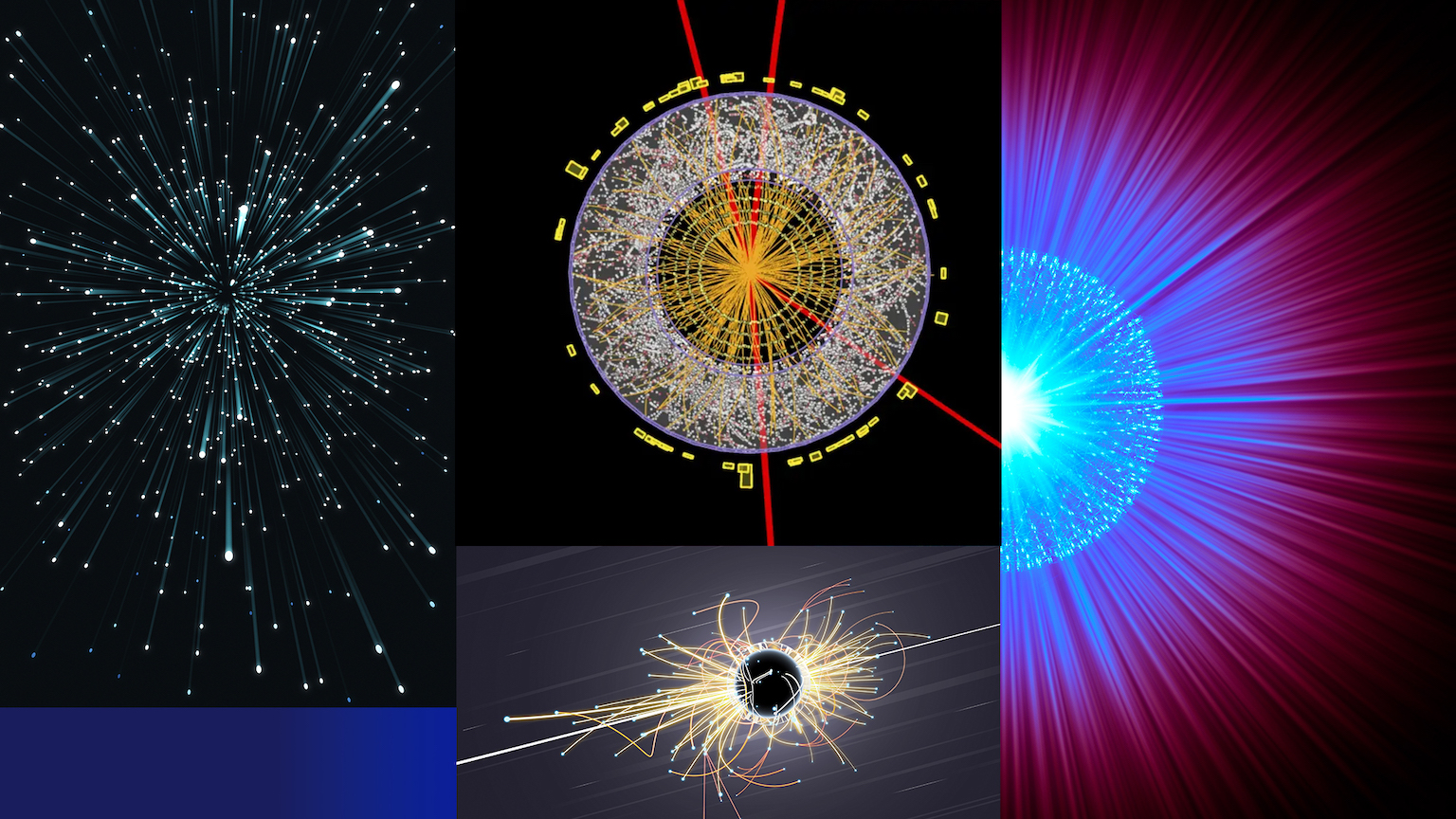
Professor Vopson thinks the prevalence of symmetry in the universe suggests we are in a simulated reality because it's a way to save computational power. The laws of physics that govern the universe are also akin to computer code, he says, while elementary particles that make up matter are like pixels.
The simulation theory is not unique to Professor Vopson; in fact, it's popular among a number of well-known figures including Tesla founder Elon Musk and American astrophysicist Neil Degrasse Tyson.
But as French philosopher René Descartes pointed out in 1637, 'Cogito, ergo sum', translated from the Latin as 'I think, therefore I am'. In other words, the ability to doubt the nature of our reality is essentially proof that we exist, in some shape or form.