
Killing the planet with kindness: the worst ChatGPT prompts - Verdict
It is no secret that ChatGPT is taking over the life of the layman. Whether it’s used for writing essays, job applications or emails, or, more concerningly, for providing reassurance to an anxiety-riddled brain, its ubiquity is undeniable. Yet equally pervasive is the very fact that every search harms the environment.
ChatGPT, which is based on the GPT-3 model, consumes a significant amount of energy during its training and operational phases. The energy consumed in the training of GPT-3 amounted to 1,287 megawatt-hours (MWh), resulting in more than 550 tonnes (t) of CO₂ emissions associated with this process.
Environmental Impact of ChatGPT
In addition to the training phase, the operational use of ChatGPT also contributes to energy consumption. A ChatGPT-like application, which is estimated to handle around 11 million requests per hour, produces approximately 12.8t of CO₂ per year. Furthermore, the energy requirements for running AI applications like ChatGPT are expected to increase significantly. Current rack power levels are around 15 kW or less, but as AI demands grow, this could rise to as much as 100 kW in the near future.
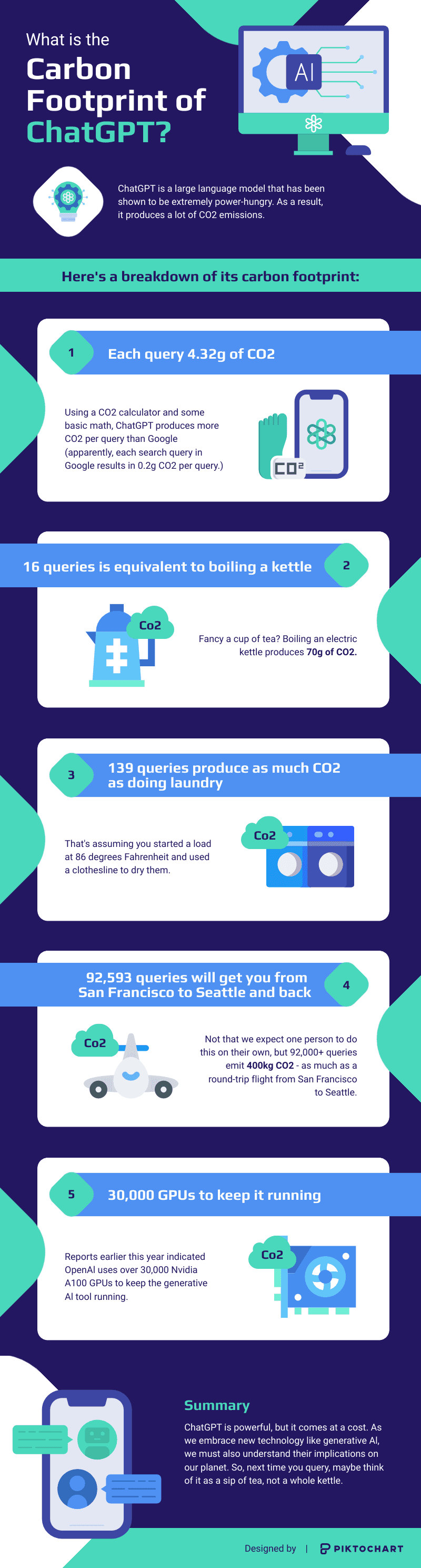
In summation, the use of ChatGPT has enormous implications for the environment’s CO₂ levels.
Energy Consumption Based on Prompts
Research has begun into exactly the kind of prompt that takes up the most energy with ChatGPT, and what the most harmful thing you can ask is. In Germany, researchers ran 14 open-source large language models (LLMS) through 1,000 benchmark questions.
Measuring the CO₂ emissions from each response, it was found that models which used internal reasoning to ‘think’ through answers could potentially produce 50 times more emissions than those which responded concisely. Questions related to philosophy or abstract algebra, which required deeper reasoning, produced far more emissions than topics like history, which pertain to more factual things.

However, perhaps most intriguingly, the increase of politeness increases emissions. When users are friendly and say ‘please’ and ‘thank you’ to ChatGPT, more words are generated.
Questions related to philosophy or abstract algebra, which required deeper reasoning, produced far more emissions than topics like history, which pertain to more factual things.
Impact on Younger Generations
These facts become concerning when we assess how younger generations are increasingly using ChatGPT as a kind of online confidante. Whether it’s late-night overthinking, navigating the stresses of school, university, and work, or even how to get over a situationship, Gen Z are turning to ChatGPT for reassurance. Yet as their relationship with the chatbot becomes more intimate and colloquial, so too does their language.
Ultimately, the concern arises as they thank ChatGPT for its service or ask it to ‘please’ help them, given that research demonstrates this uses more energy and emits more CO₂.

Gen Z may be environmentally conscious, yet their intimacy with the digital world is now proving to be harmful to the planet. As Gen Z increasingly lean on ChatGPT for emotional support and companionship, the environmental cost of constant AI usage often goes unnoticed. While digital conversations may feel weightless, every chat leaves a carbon footprint. Even virtual friendships have real-world consequences.
The gold standard of business intelligence. Find out more
Give your business an edge with our leading industry insights.
Thematic Take (monthly)
I consent to Verdict Media Limited collecting my details provided via this form in accordance with Privacy Policy
View all newsletters from across the GlobalData Media network.
Decrypting the latest technology news Powered by  © Verdict Media Limited 2025