
It's America's fastest-growing job – thanks to ChatGPT | News ...
Jobs in AI-related fields have spiked since the release of ChatGPT in late 2022. On the hunt for a new job? Building artificial intelligence tech could be a safe option. The market for jobs in the AI sector has surged in the last two years, according to a recent analysis from the University of Maryland and job-tracking firm LinkUp — the latest in a slew of studies indicating AI skills are in high demand.
The ChatGPT Effect
Anil Gupta, a professor of strategy, globalization, and entrepreneurship at the University of Maryland’s Smith School of Business who co-led the research, said the analysis showed a clear “ChatGPT effect,” referring to how the OpenAI-developed chatbot’s launch led to the job posting spike – replacing many IT-related job listings.
The analysis comes from AIMaps, a collaboration between the University of Maryland’s Smith School of Business and LinkUp. The program tracks the growth of AI jobs across different sectors in the United States, such as manufacturing and retail.

Job Market Trends
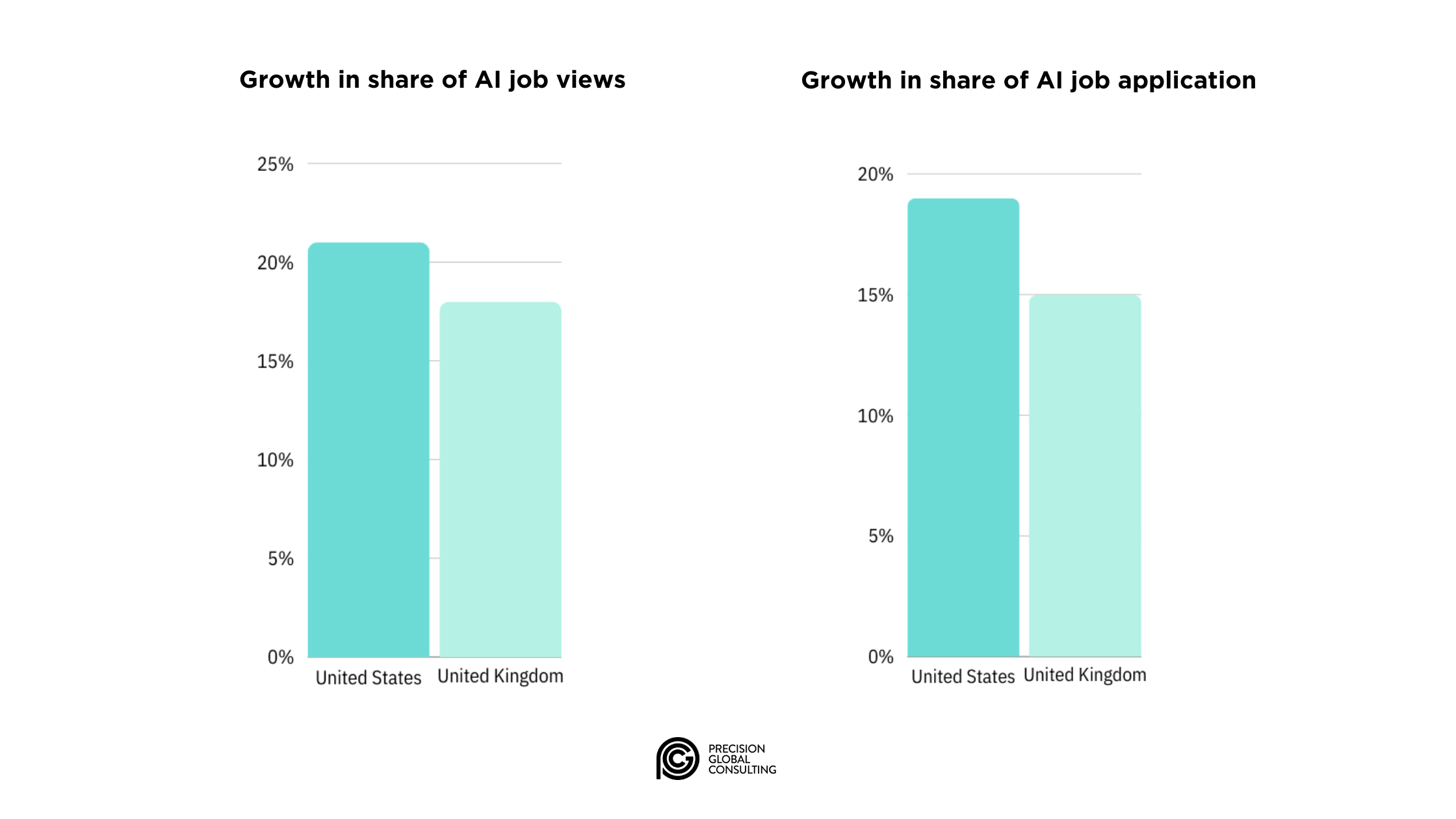
Job postings in AI fields have spiked 68% in the United States since the end of 2022, while overall job postings have declined 17% in the same period, according to the AIMaps data. According to ZipRecruiter data provided to CNN, AI job postings on the site grew 124% from 2023 to the end of 2024.
Challenges and Opportunities
While AI has resulted in some new types of jobs, tech giants have also slashed their workforces after announcing major investments in AI technology — though not all the layoffs were because AI replaced human workers.
“We already know GitHub Copilot and other AI tools are able to do 60-70% of the coding,” Gupta said. “Four people can do the job of 10.”
The Global Impact
The global AI race is only getting started, as evidenced by the recent release of DeepSeek, a Chinese startup that shook the market with an AI model reportedly developed at a fraction of the cost of American competitors like ChatGPT.

Continued Investments
Over two years since ChatGPT helped spark an AI boom, American tech giants are still making hefty investments in their AI programs. In January, Microsoft announced plans to invest about $80 billion in fiscal 2025 on AI data centers, and President Donald Trump announced the creation of Stargate, a collaboration between OpenAI, SoftBank, and Oracle that plans to invest up to $500 billion in AI infrastructure in the coming years.
Industry Developments and Challenges
Artificial intelligence jobs are in especially high demand in the consulting sector, Gupta said, since non-AI firms typically hire consulting firms like Accenture and Bain to help develop AI tools — for example, a machine learning engineer or a product manager for a generative AI tool.
But many companies may still be slow to adopt the technology amid potential privacy and security risks.
Impact on the Job Market
AI job growth is occurring alongside a broader slowdown in hiring across the job market. Despite the higher demand for AI jobs, it is too soon to tell how the AI boom is impacting specific jobs.
“We think that the jobs that are in particular adopting AI are seeing larger hiring declines,” Simon said.
Evolution of Workforce Dynamics
Companies’ efforts to “do more with less” extend beyond using AI in the workplace, with Revelio Labs reporting last week that US companies are increasingly hiring for high-skilled positions abroad.
Future Prospects
As for fears that AI will lead to mass unemployment, Gupta offered a more optimistic view, saying he believes the corporate world will instead adapt to the efficiency enabled by the technology.
“There was a time when a six-day work week was the norm, and now (we have a) five-day work week,” Gupta said. “Could it be that in 10-20 years, it’s a four-day work week? I think the prospects of that are very, very high.”








