Azure Open AI and Bing Search: Innovating Enterprise Decision Making
Today, businesses need to make quick and smart decisions using lots of data. This article talks about how companies can use Azure Open AI and Azure Bing Search, along with LangChain, to bring together detailed internal data with new public information from the web. We will look at how these tools work together to study job markets for Azure AI roles in New York. Using LangChain to connect Azure Open AI and Bing Search can help organizations not only analyze more data but also quickly adjust to new market trends.
Business Case: Azure AI Job Market Analysis in New York
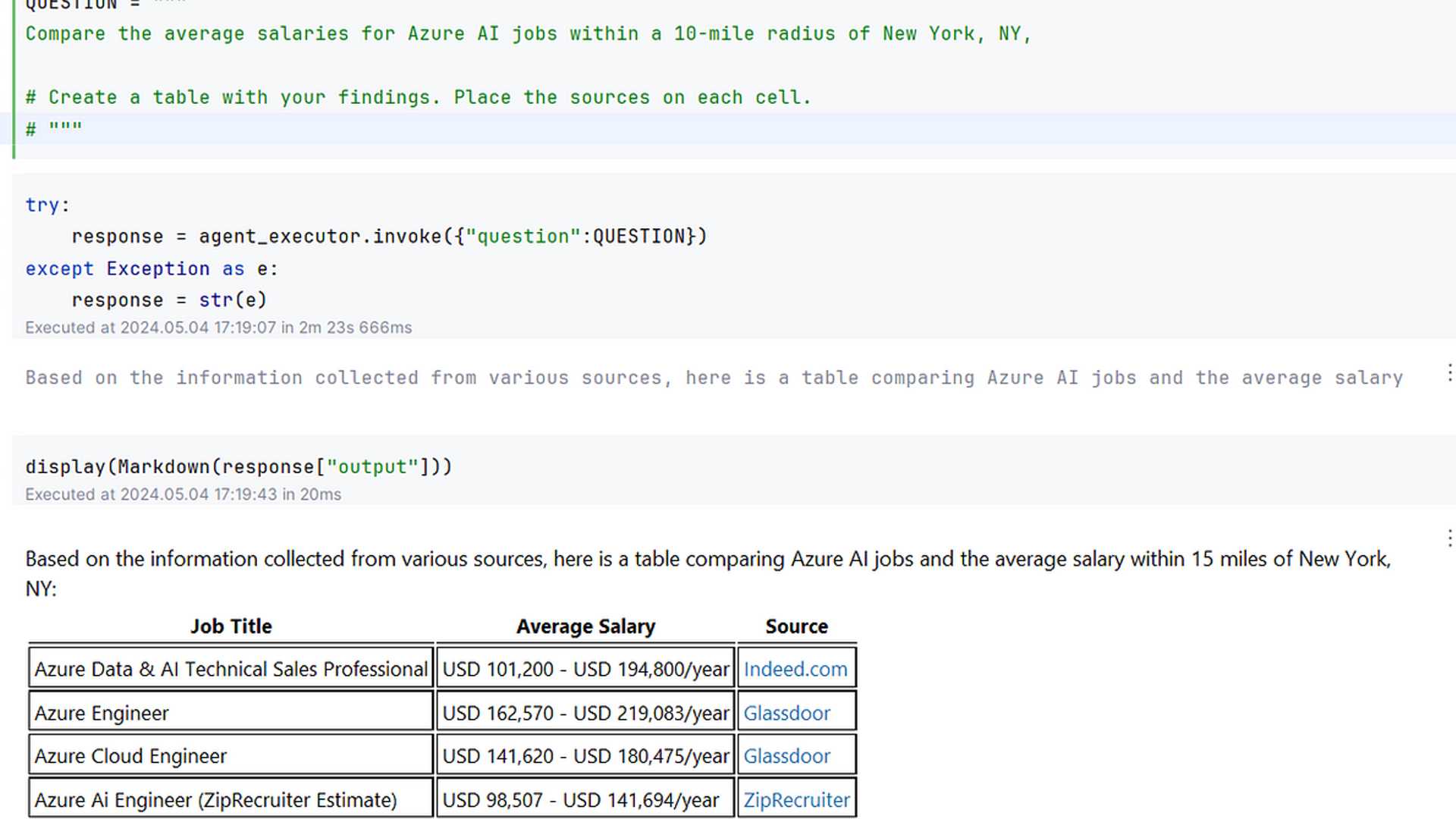
To understand the Azure AI job market in New York, we use Azure Bing Search to gather up-to-date job listings and salary information. Azure Open AI then analyzes and summarizes this data to identify key market trends. In this scenario, while focusing on external public data, LangChain plays a crucial role as both an agent and a tool, orchestrating the workflow between Azure Bing Search and Azure Open AI to ensure seamless data processing and analysis. This streamlined integration allows for effective aggregation and synthesis of data, enhancing our analytical capabilities.
Although this example leverages public data, LangChain also offers the potential to integrate such data with internal enterprise data, providing a richer, more comprehensive analysis.
For further insight into how internal enterprise data can be integrated with LLM systems using Azure Open AI and LangChain, refer to my earlier articles: "RAG Explained: Showcasing Azure’s No-code/Low-code LLMOps alongside LangChain Expertise" and "RAG on SQL Database Using Azure OpenAI and LangChain". This approach not only enhances our current project but also demonstrates LangChain’s versatility in handling various data integration scenarios, empowering the company to adapt quickly to market changes and maintain competitive hiring practices.
Example of Findings from Azure Open AI & Bing Search: Azure AI Jobs Salary Comparison in New York, NY
 Azure OpenAI, accessible through a scalable cloud-based platform, leverages advanced GPT models such as GPT-4 for sophisticated text analysis and data processing tasks. These models excel in interpreting and synthesizing large datasets, making them ideal for applications requiring deep understanding of complex data structures.
Azure Bing Search serves as a critical tool for real-time data retrieval, enabling businesses to access up-to-date information from the web. By integrating Bing Search APIs into our data systems, we can automatically query and retrieve current data on global market trends, public opinions, and specific industry developments.
LangChain plays a crucial role as both an agent and a tool, orchestrating the integration and interaction between Azure OpenAI and Microsoft Bing Search within our framework. It leverages LangChain’s capabilities to manage complex workflows, coordinating data retrieval from Bing Search and subsequent processing and analysis using Azure OpenAI. As an agent, LangChain directs the flow of data between these external and internal services, ensuring that data fetched by Bing Search is efficiently processed by Azure OpenAI for insightful analysis.
The integration of Azure Open AI, Azure Bing Search, and LangChain significantly enhances organizational data management and decision-making capabilities. Azure Open AI provides deep analysis of vast data sets, while Azure Bing Search supplies up-to-the-minute global information, ensuring decisions are informed by current trends. LangChain facilitates seamless interaction between these technologies, optimizing data processing and automation. This trio not only streamlines operations but also empowers businesses with the agility and accuracy needed for strategic planning and competitive advantage.
For more insights into the technical implementation, see the reference project on GitHub that inspired this setup: GPT-Azure-Search-Engine. This powerful integration exemplifies the future of business intelligence, blending advanced AI analytics with real-time data access to redefine enterprise strategies.
This story is published under Generative AI Publication.
Connect with us on Substack, LinkedIn, and Zeniteq to stay in the loop with the latest AI stories. Let’s shape the future of AI together!