Meta fends off authors' US copyright lawsuit over AI
A federal judge ruled on Wednesday for Meta Platforms against a group of authors who had argued that its use of their books without permission to train its artificial intelligence system infringed their copyrights.
Ruling by the U.S. District Judge
U.S. District Judge Vince Chhabria, in San Francisco, said in his decision that the authors had not presented enough evidence that Meta’s AI would dilute the market for their work to show that the company’s conduct was illegal under U.S. copyright law.
Chhabria also said, however, that using copyrighted work without permission to train AI would be unlawful in “many circumstances,” splitting with another federal judge in San Francisco who found on Monday in a separate lawsuit that Anthropic’s AI training made “fair use” of copyrighted materials.
Author's Law Firm Response
A spokesperson for the authors’ law firm Boies Schiller Flexner said that it disagreed with the judge’s decision to rule for Meta despite the “undisputed record” of the company’s “historically unprecedented pirating of copyrighted works.”
Meta's Response
 A Meta spokesperson said the company appreciated the decision and called fair use a “vital legal framework” for building “transformative” AI technology.
The authors sued Meta in 2023, arguing the company misused pirated versions of their books to train its AI system Llama without permission or compensation.
Legal Doctrine of Fair Use
The legal doctrine of fair use allows the use of copyrighted works without the copyright owner’s permission in some circumstances. It is a key defense for the tech companies.
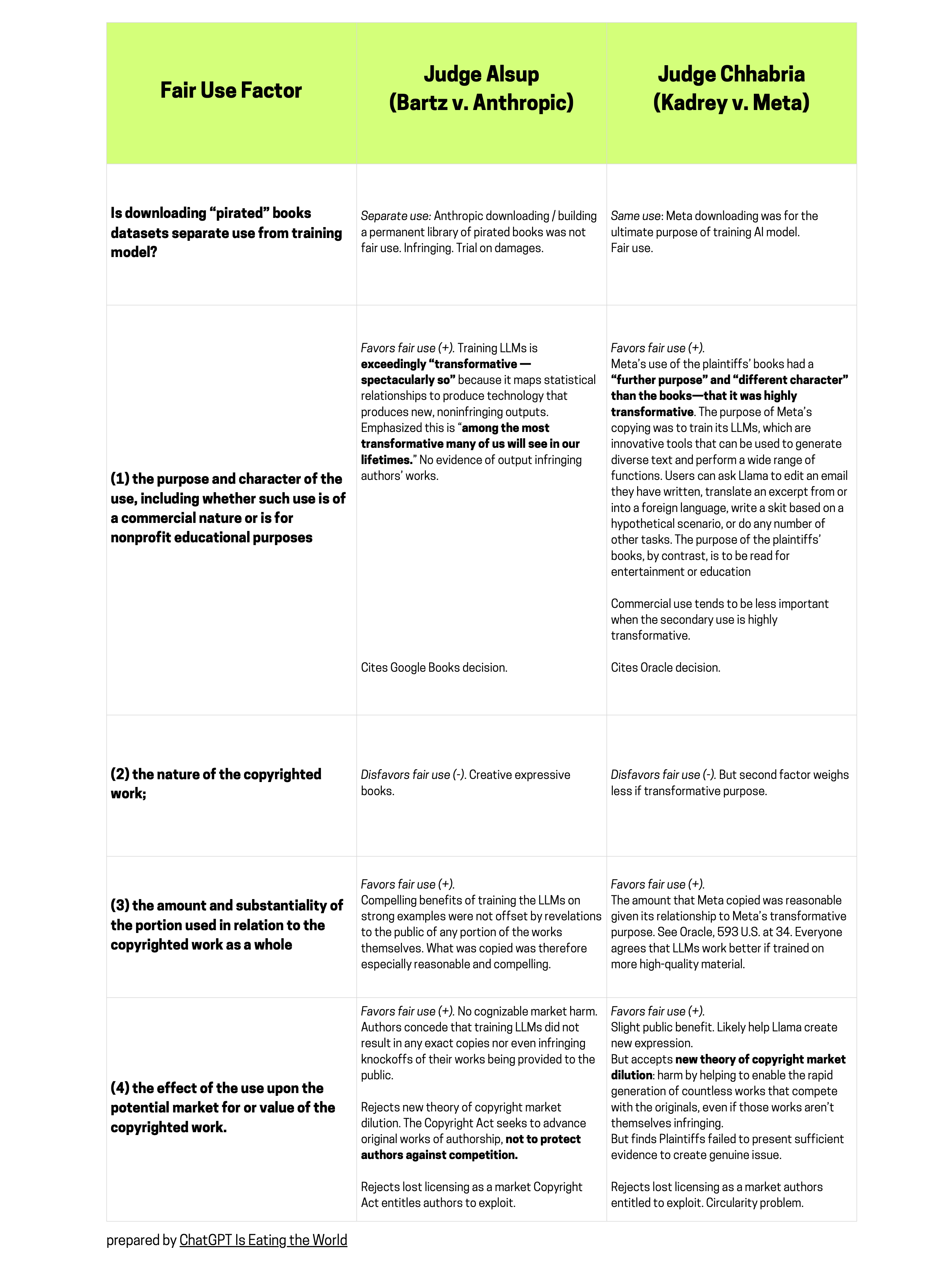 Chhabria’s decision is the second in the U.S. to address fair use in the context of generative AI, following U.S. District Judge William Alsup’s ruling in the Anthropic case.
Arguments from AI Companies and Copyright Owners
AI companies argue their systems make fair use of copyrighted material by studying it to learn to create new, transformative content, and that being forced to pay copyright holders for their work could hamstring the burgeoning AI industry.
Copyright owners say AI companies unlawfully copy their work to generate competing content that threatens their livelihoods. Chhabria expressed sympathy for that argument during a hearing in May, which he reiterated on Wednesday.
Conclusion
The judge said generative AI had the potential to flood the market with endless images, songs, articles, and books using a tiny fraction of the time and creativity that would otherwise be required to create them.
“So by training generative AI models with copyrighted works, companies are creating something that often will dramatically undermine the market for those works, and thus dramatically undermine the incentive for human beings to create things the old-fashioned way,” Chhabria said. (REUTERS)








