Asking ChatGPT vs Googling: Can AI chatbots boost human creativity?
Think back to a time when you needed a quick answer, maybe for a recipe or a DIY project. A few years ago, most people’s first instinct was to “Google it.” Today, however, many people are more likely to reach for ChatGPT, OpenAI’s conversational AI, which is changing the way people look for information. Rather than simply providing lists of websites, ChatGPT gives more direct, conversational responses. But can ChatGPT do more than just answer straightforward questions? Can it actually help people be more creative?
I study new technologies and consumer interaction with social media. My colleague Byung Lee and I set out to explore this question: Can ChatGPT genuinely assist people in creatively solving problems, and does it perform better at this than traditional search engines like Google? Across a series of experiments in a study published in the journal Nature Human Behavior, we found that ChatGPT does boost creativity, especially in everyday, practical tasks. Here’s what we learned about how this technology is changing the way people solve problems, brainstorm ideas, and think creatively.
ChatGPT and creative tasks
Imagine you’re searching for a creative gift idea for a teenage niece. Previously, you might have googled “creative gifts for teens” and then browsed articles until something clicked. Now, if you ask ChatGPT, it generates a direct response based on its analysis of patterns across the web. It might suggest a custom DIY project or a unique experience, crafting the idea in real-time.

To explore whether ChatGPT surpasses Google in creative thinking tasks, we conducted five experiments where participants tackled various creative tasks. For example, we randomly assigned participants to either use ChatGPT for assistance, use Google search, or generate ideas on their own. Once the ideas were collected, external judges, unaware of the participants’ assigned conditions, rated each idea for creativity. We averaged the judges’ scores to provide an overall creativity rating.
One task involved brainstorming ways to repurpose everyday items, such as turning an old tennis racket and a garden hose into something new. Another asked participants to design an innovative dining table. The goal was to test whether ChatGPT could help people come up with more creative solutions compared with using a web search engine or just their imagination.
Limits of AI creativity
ChatGPT’s strength lies in its ability to combine unrelated concepts into a cohesive response. Unlike Google, which requires users to sift through links and piece together information, ChatGPT offers an integrated answer that helps users articulate and refine ideas in a polished format. This makes ChatGPT promising as a creativity tool, especially for tasks that connect disparate ideas or generate new concepts.
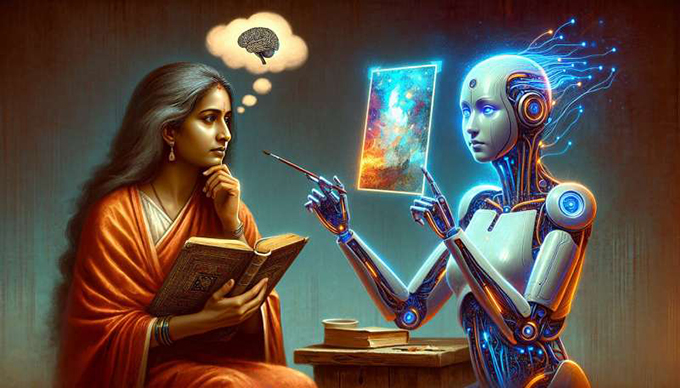
It’s important to note, however, that ChatGPT doesn’t generate truly novel ideas. It recognizes and combines linguistic patterns from its training data, subsequently generating outputs with the most probable sequences based on its training. If you’re looking for a way to make an existing idea better or adapt it in a new way, ChatGPT can be a helpful resource. For something groundbreaking, though, human ingenuity and imagination are still essential.
Future of AI and creativity
As ChatGPT and similar AI tools become more accessible, they open up new possibilities for creative tasks. Whether in the workplace or at home, AI could assist in brainstorming, problem-solving, and enhancing creative projects. However, our research also points to the need for caution: While ChatGPT can augment human creativity, it doesn’t replace the unique human capacity for truly radical, out-of-the-box thinking.
This shift from Googling to asking ChatGPT represents more than just a new way to access information. It marks a transformation in how people collaborate with technology to think, create, and innovate.