Meet AI Co-Scientist: A Multi-Agent System Powered by Gemini 2.0
Biomedical researchers are faced with a challenging dilemma as they strive for groundbreaking scientific discoveries. The complexity of biomedical subjects requires specialized expertise, while innovative insights often arise at the convergence of various disciplines. This dichotomy between depth and breadth presents significant hurdles for scientists who must navigate a rapidly expanding sea of publications and advanced technologies.
Despite these challenges, major scientific breakthroughs frequently result from interdisciplinary approaches, such as the development of CRISPR. This groundbreaking technique combines methodologies from microbiology, genetics, and molecular biology, demonstrating how breaking traditional barriers can spur scientific advancement.
The Role of AI in Scientific Discovery
In recent years, there has been a shift towards developing specialized "reasoning models" that aim to enhance human thought processes rather than simply predicting outcomes. The test-time compute paradigm has emerged as a promising avenue, allowing for increased computational resources during inference to facilitate deliberate reasoning. This concept has evolved from early successes like AlphaGo's Monte Carlo Tree Search to more advanced models such as LLMs.
AI has revolutionized scientific exploration across various domains, with AlphaFold 2's breakthrough in protein structure prediction serving as a prime example. Researchers are now working towards seamlessly integrating AI into the research workflow, envisioning AI as an active collaborator throughout the scientific process, from hypothesis generation to manuscript drafting.
The Emergence of AI Systems in Biomedical Research
A multitude of AI systems have been developed to expedite scientific discovery in the field of biomedical research. One notable system is Coscientist, a multi-agent system powered by GPT-4 that enables autonomous execution of chemical experiments by leveraging integrated web searching and code execution capabilities.
General-purpose models like GPT-4 and specialized biomedical LLMs such as Med-PaLM have demonstrated impressive performance on biomedical reasoning benchmarks. However, challenges persist in areas like drug repurposing, where approaches combining computational and experimental methods face limitations in scalability and explainability. 
The AI Co-Scientist: Accelerating Scientific Discovery
A collaborative effort involving researchers from various institutions has led to the proposal of an AI co-scientist, a multi-agent system built on Gemini 2.0 with the aim of expediting scientific discovery. This innovative system is designed to uncover new knowledge and generate novel research hypotheses aligned with scientist-provided objectives.
By employing a "generate, debate, and evolve" approach, the AI co-scientist leverages test-time compute scaling to enhance hypothesis generation. Its focus spans three key biomedical domains: drug repurposing, novel target discovery, and the elucidation of bacterial evolution mechanisms.
The Architecture of the AI Co-Scientist System
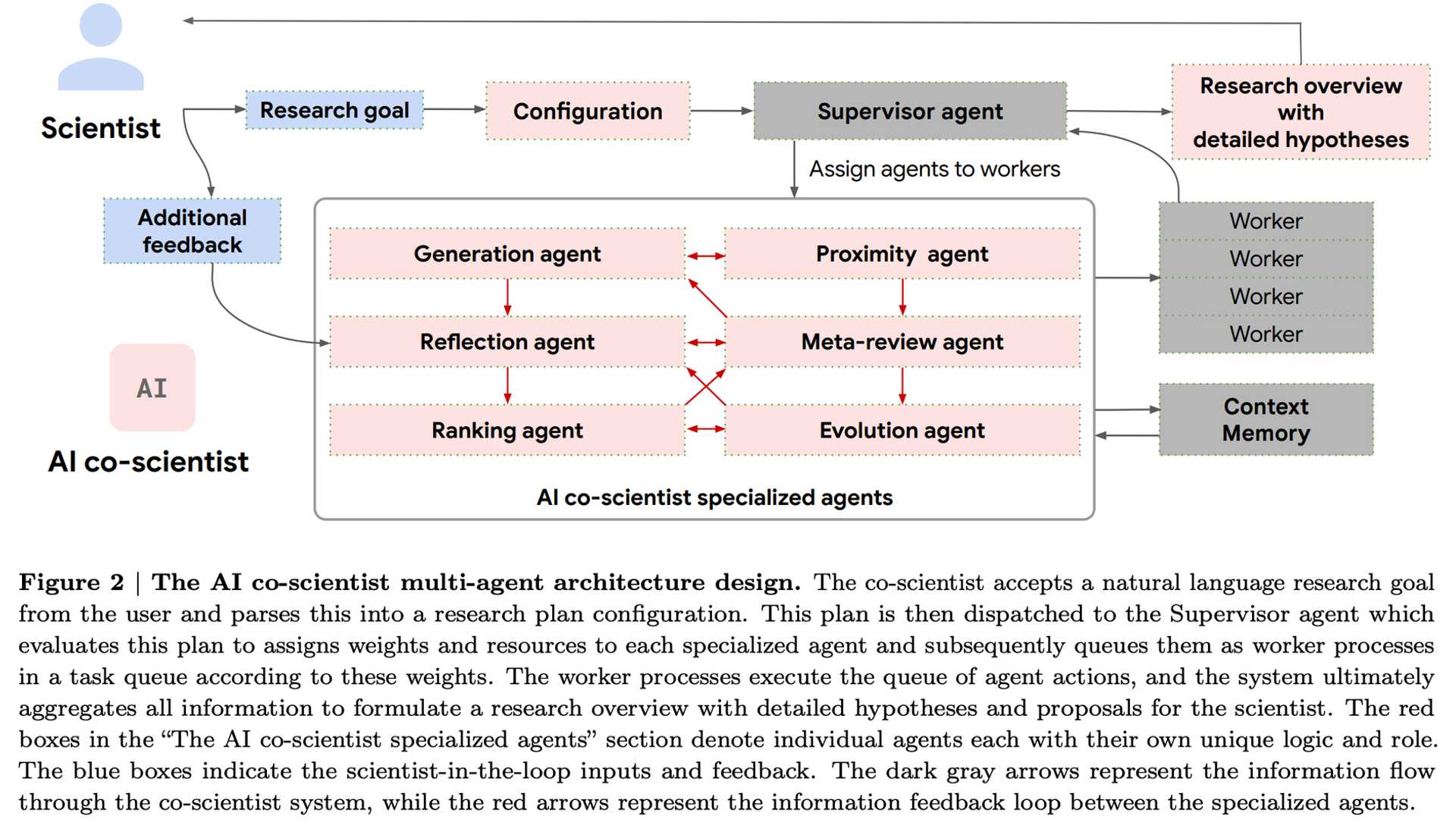
The AI co-scientist system integrates four essential components to form a comprehensive research system:
- Generation agent: Initiates research by creating focus areas and hypotheses
- Reflection agent: Acts as a peer reviewer to assess hypothesis quality
- Ranking agent: Implements a tournament system to prioritize hypotheses
- Proximity agent: Computes similarity graphs for efficient exploration
Additionally, the Evolution and Meta-review agents continuously refine hypotheses based on feedback and insights gathered during the research process.
Performance and Impact of the AI Co-Scientist System
Performance evaluations of the AI co-scientist system have yielded promising results across multiple metrics. The system has demonstrated high accuracy in hypothesis selection and has shown competitive performance compared to newer reasoning models. Expert evaluations have confirmed the system's effectiveness, with outputs receiving favorable ratings for novelty and impact.
Furthermore, experiments conducted across various biomedical research domains have showcased the AI co-scientist's capabilities in generating actionable hypotheses with real-world applications, such as identifying potential therapeutic targets for liver fibrosis treatment and guiding antimicrobial resistance research. 
Limitations and Future Development
While the AI co-scientist system shows great potential, it currently faces limitations in generating comprehensive clinical trial designs and accounting for various factors in drug repurposing and discovery processes. Future developments should focus on enhancing literature reviews, incorporating external tools, improving factuality verification, and expanding data sources beyond textual analysis.
Integrating the system with laboratory automation tools and enhancing user interfaces for improved human-AI collaboration represent key areas for future growth and innovation.
In Conclusion
The introduction of the AI co-scientist system marks a significant advancement in leveraging AI for accelerating scientific discovery. By combining specialized agents in a collaborative framework, the system demonstrates remarkable potential in generating novel hypotheses that withstand rigorous scrutiny. As researchers tackle increasingly complex challenges in biomedical research, systems like the AI co-scientist offer valuable support in expediting the discovery process and pushing the boundaries of scientific exploration.
For more information, you can check out the research paper.